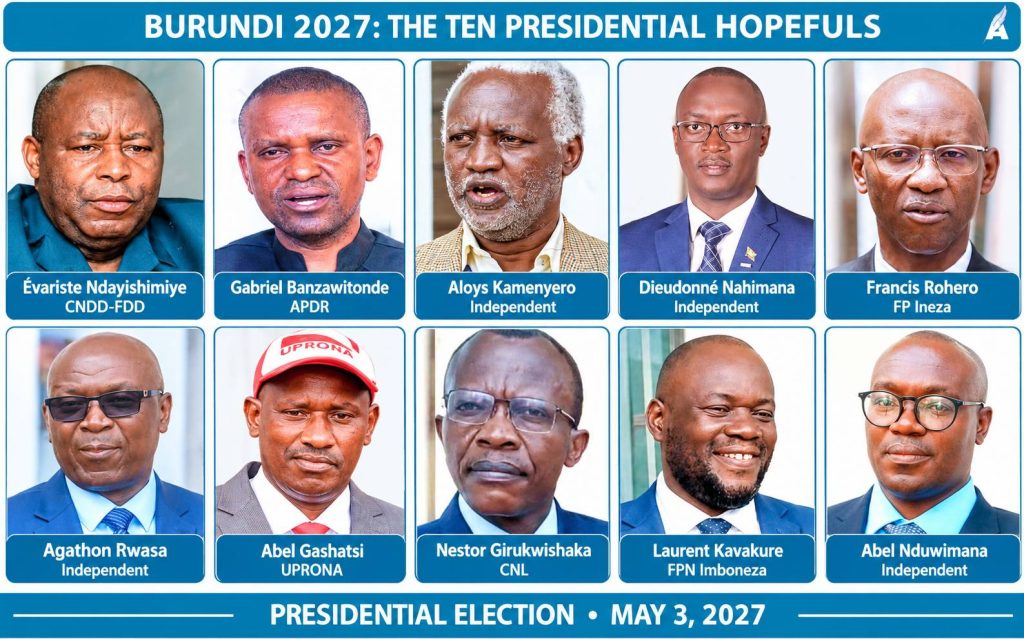
Ten presidential hopefuls have submitted their candidacy applications to Burundi’s Independent National Electoral Commission (CENI) ahead of the May 3, 2027, presidential election, setting the stage for a contest involving the incumbent president, opposition figures and independent candidates with different political ambitions.
The commission received applications from six political party representatives and four independent candidates before the November 22 deadline, according to CENI President Prosper Ntahorwamiye. The applications will now undergo an eligibility review to determine which hopefuls will appear on the final ballot.
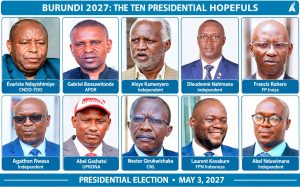
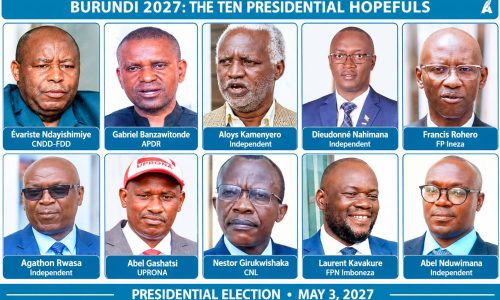
The ten applicants are President Évariste Ndayishimiye of the ruling National Council for the Defense of Democracy–Forces for the Defense of Democracy (CNDD-FDD); Abel Gashatsi of the Union for National Progress (UPRONA); Gabriel Banzawitonde of the Alliance for Peace, Democracy and Reconciliation (APDR); Francis Rohero of FP Ineza; Agathon Rwasa, running as an independent; Aloys Kamenyero, also an independent; Abel Nduwimana, an independent; Laurent Kavakure of FPN Imboneza; Dieudonné Nahimana, an independent; and Nestor Girukwishaka of the National Congress for Liberty (CNL).
Ndayishimiye, who has been in office since 2020, is seeking a second seven-year term after receiving his party’s endorsement in April 2026. Eleven other political parties have also announced their support for his candidacy.
He submitted his application on November 13, among the first hopefuls to complete the process. His bid comes as his administration faces public concerns over fuel shortages, rising living costs and broader economic difficulties.
Abel Gashatsi, representing UPRONA, also submitted his application on November 13. He called on CENI to maintain its independence and ensure that the electoral process is conducted credibly.
Gabriel Banzawitonde of APDR submitted his documents on November 16, expressing confidence in his party’s ability to meet the requirements and compete in the election.
Francis Rohero of FP Ineza and Agathon Rwasa submitted their applications on November 21, alongside Aloys Kamenyero, whose candidacy is based on a markedly different political vision.
Rohero said he decided to enter the race because elections provide an opportunity for political change. He argued that no country should remain under the same leadership indefinitely and that citizens should continue to believe in the possibility of choosing a different direction.
Rwasa, a prominent opposition figure and former leader of the CNL, is seeking the presidency as an independent candidate following a dispute over the leadership of his former party.
The dispute dates back to March 10, 2024, when a party congress appointed new leadership without his knowledge, according to Rwasa. He maintains that he was removed from the party leadership through what he describes as force.
To justify his independent candidacy, Rwasa cites Article 99, paragraph 3, of Burundi’s Constitution, which provides for former members of political party leadership to contest independently after two years following their removal or resignation.
He argues that more than two years and eight months have passed since the March 2024 events, making him eligible to run independently. However, the final interpretation and application of the constitutional provision rest with the electoral authorities.
Kamenyero, meanwhile, says his political ambition goes beyond becoming president. He told journalists that voters who support him would be rejecting the republican system in favour of restoring the monarchy in Burundi.
His application, however, was incomplete. He acknowledged that he had not provided the required electoral deposit of 100 million Burundian francs and that several supporting documents were missing. He attributed the omissions partly to an electricity outage at his home, which he said prevented him from preparing the necessary paperwork.
Four more hopefuls submitted their applications on November 22, the final day of the registration period: Abel Nduwimana, Laurent Kavakure, Dieudonné Nahimana and Nestor Girukwishaka.
Nduwimana, a former Catholic priest who identified himself as originally from Kiganda in Gitega Province, submitted his documents but declined to comment to journalists. His entry into politics followed his decision to suspend his priestly duties to pursue a political career.
Kavakure, representing FPN Imboneza, highlighted logistical difficulties encountered while preparing his application. He said electricity interruptions disrupted photocopying work involving his team and called on CENI to consider reducing the volume of documents required from presidential candidates.
Nahimana, who contested the 2020 and 2025 presidential elections, is seeking the presidency for a third consecutive time. He said his decision to run again was driven by persistent socioeconomic challenges, including fuel shortages, rising prices and the difficulties experienced by ordinary Burundians.
“If we continue to present ourselves, it is because the problems facing Burundians have still not been solved. The important thing is that Burundians still have needs that we are capable of addressing,” Nahimana said after submitting his application.
He argued that the country still faces problems requiring solutions and that his continued participation reflects his commitment to addressing citizens’ concerns.
The final applicant, Nestor Girukwishaka, represents the CNL, the party previously led by Rwasa. His candidacy adds another dimension to the party’s political history, which has been marked by internal leadership disputes and divisions.
With the application period closed, CENI is expected to examine the ten submissions between November 23 and 26. The commission is scheduled to communicate its decisions on November 27, indicating which applications have been accepted or rejected.
The final list of candidates approved to contest the May 3, 2027, presidential election is expected on December 6, 2026.
Submitting an application does not automatically guarantee a place on the ballot. CENI must verify that each hopeful meets the constitutional and electoral requirements, including the necessary documentation and financial obligations.
The forthcoming review will therefore be decisive, particularly for candidates whose applications have raised questions about missing documents or eligibility.
For Burundi, the 2027 presidential election will determine who leads the country for the next seven-year term. But before the political contest officially begins, the ten hopefuls must first convince the electoral commission that they meet the requirements to compete.