As dawn breaks over the hills of Burundi, thousands of farmers begin another day in fields that feed both their families and the nation. For many, the success of a harvest depends on one crucial input: fertilizer.
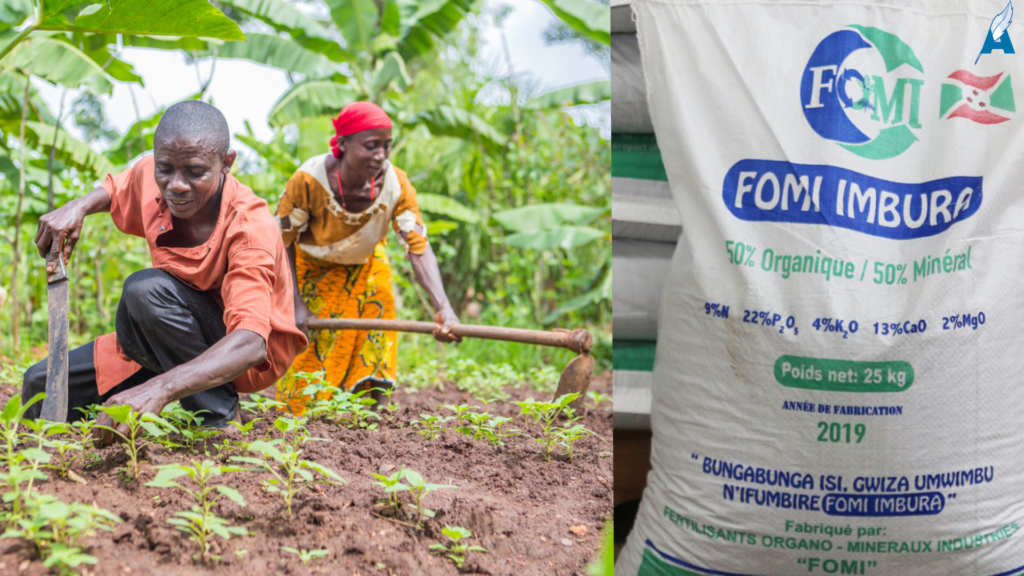
In recent years, the Burundian government has made fertilizer use a cornerstone of its agricultural strategy, promoting higher yields and improved food security through subsidized inputs. At the heart of this effort is Fertilisants Organo-Minéraux Industries (FOMI), a domestic company established to produce fertilizer locally and reduce dependence on imports.
Yet despite ambitious promises and growing investment, many farmers say the reality on the ground tells a different story.
Across several provinces, reports of delayed deliveries, missing orders, and fertilizer shortages have sparked frustration among producers who fear that bureaucratic bottlenecks and distribution failures are undermining the very agricultural transformation the government seeks to achieve.
Their complaints reveal a broader issue—one that extends beyond agriculture and into the realm of consumer rights, market accountability, and economic development.
A Race Against Time
For farmers, fertilizer is not simply another commodity. It is a time-sensitive product whose value depends on arriving at the right moment.
Missing the planting season by a few weeks can mean losing an entire harvest.
In the northern province of Butanyerera and other agricultural regions, farmers interviewed by Andika Magazine said they had paid for fertilizer months in advance but were still waiting for delivery as the planting season approached. Others reported receiving only part of the quantities they ordered.
“We don’t know where the fertilizers are,” one farmer said, expressing a concern shared by many producers who fear lower yields and reduced income if supplies fail to arrive on time.
The uncertainty comes at a particularly challenging moment. Burundi continues to face pressure to increase agricultural production in a country where more than 80 percent of the population relies on farming for their livelihoods.
For smallholder farmers operating on narrow margins, delayed fertilizer deliveries can have consequences far beyond a single season. Lower yields often translate into lower household incomes, reduced purchasing power, and increased food insecurity.
Farmers Are Consumers Too
The complaints highlight an often-overlooked reality: farmers are not only producers; they are consumers.
They purchase goods, make advance payments, and rely on promises made by suppliers and public institutions. Like any consumer, they have a right to receive the products they paid for, in the quantity promised and within a reasonable timeframe.
This principle lies at the heart of consumer protection frameworks across the COMESA region.
The COMESA Competition and Consumer Commission (CCCC) promotes fair markets and seeks to protect consumers from unfair practices. While discussions around consumer rights frequently focus on urban markets or digital commerce, the experiences of Burundian farmers demonstrate that consumer protection is equally important in rural economies.
When fertilizer paid for in advance does not reach farmers on time, questions arise about transparency, accountability, and access to effective remedies.
Who is responsible?
Who compensates affected farmers?
And how can consumers seek redress when institutions point to one another?
The FOMI Response
Company officials have stated that FOMI does not directly collect money from farmers and that payments are managed through government channels.
In addressing allegations of supply shortages, extreme delays, and corruption, FOMI’s Deputy General Manager, Herménégilde Manyange, argued that the issue stems from complex systemic constraints rather than corporate negligence.
According to the company, fertilizer production has continued while administrative and logistical challenges elsewhere in the supply chain have contributed to delays.
In a public statement, company representatives emphasized that FOMI’s responsibility is primarily production and supply, not the management of payments made by farmers.
Yet for many farmers, institutional distinctions matter little.
Their concern is straightforward: they paid for fertilizer and expected to receive it before the planting season.
Government Under Pressure
The growing controversy has prompted government intervention.
On March 19, 2026, officials from the Ministry of Agriculture and Livestock and the Ministry of Finance, Budget and Digital Economy visited FOMI facilities to assess production capacity and evaluate the causes of distribution challenges.
The visit reflected growing recognition that fertilizer shortages are not merely an operational issue. They have implications for food security, rural livelihoods, and public confidence in agricultural programs.
Government officials acknowledged the importance of ensuring that fertilizer reaches farmers on time, particularly as Burundi seeks to boost agricultural productivity and reduce poverty.
The challenge is substantial.
Demand for fertilizer has increased significantly as more farmers adopt modern agricultural practices. At the same time, managing procurement, transportation, storage, and distribution across the country’s diverse terrain remains a logistical challenge.
A Competition and Consumer Protection Issue
Beyond the immediate concerns of farmers, the fertilizer crisis offers important lessons about competition and consumer protection.
Efficient markets depend on transparency and trust. Consumers must know what they are purchasing, when it will be delivered, and what options exist when commitments are not met.
When formal distribution systems fail, consumers often seek alternatives. In the case of fertilizers, shortages can encourage the emergence of informal markets where prices are higher and product quality may be uncertain.
Such situations can distort competition, disadvantage honest suppliers, and expose consumers to greater risks.
This is precisely why consumer protection and competition policies matter. They help create conditions where markets function fairly, information flows openly, and consumers have confidence that their rights will be respected.
Beyond Fertilizer
Burundi’s fertilizer challenges are ultimately about more than agricultural inputs.
They are about the relationship between citizens and institutions.
They are about whether a farmer in Gitega, Ngozi, Bururi, or Cibitoke can trust that a payment made today will result in a delivery tomorrow.
They are about accountability in public programs and the effectiveness of systems designed to support economic development.
The country has made significant investments in domestic fertilizer production, and FOMI remains a key part of Burundi’s strategy to modernize agriculture. But production alone is not enough.
A successful agricultural market requires transparent distribution systems, accessible complaint mechanisms, accurate information, and clear lines of responsibility.
For many farmers, the issue is not whether fertilizer exists in warehouses. It is whether it arrives in their fields when they need it most.
As Burundi works toward greater food security and agricultural self-sufficiency, ensuring that farmers are protected not only as producers but also as consumers may prove just as important as increasing fertilizer production itself.
Because in the end, a bag of fertilizer sitting in storage feeds no one.
And for the farmer waiting anxiously for the rains, timing can mean the difference between abundance and hardship.