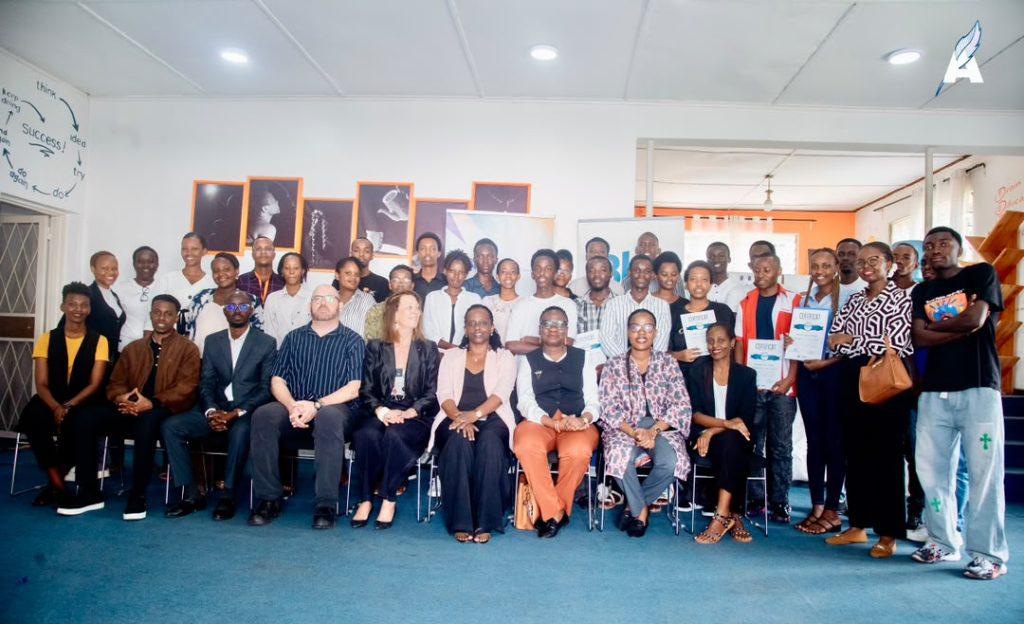
Funded by the Embassy of Israel in Burundi and implemented by 3hi Partners, the second edition of the Impact Driven Israel-Burundi Innovation Week brought together 26 young Burundians at Huza Hub from November 16 to 20, 2026, for five days of practical training, field visits and startup development.
The programme, designed to strengthen entrepreneurship and innovation among young people, brought together participants aged between 18 and 30 to develop technology-driven solutions to challenges facing their communities.
The initiative focused on four key areas considered essential to development: agricultural technology (AgriTech), financial technology (FinTech), educational technology (EdTech) and clean technology (CleanTech).
At the opening ceremony, Nitanga Bukuru Benitha, speaking on behalf of 3hi Partners, said the programme was founded on the belief that young people should not be viewed merely as beneficiaries of development but as active participants capable of identifying problems and creating solutions.
“The young people should not only be considered beneficiaries of development, but also actors capable of identifying the challenges facing their communities and proposing solutions,” she said.
She also expressed appreciation to the Israeli Embassy for its partnership and support, particularly for facilitating the participation of Israeli innovation expert Anne Baer, CEO of IKare Innovation, who led the training sessions.
Learning from Israel’s innovation experience
During the first day, Baer introduced participants to Israel’s innovation ecosystem, exploring how the country has transformed its constraints into opportunities through education, research, technological development and entrepreneurship.
Using comparisons between Burundi and Israel, including their geographical size, languages and independence histories, she encouraged participants to consider how countries with limited resources can develop competitive innovation ecosystems.
She highlighted the importance of investing in education and research, developing engineering skills and building strong universities. She also discussed the role of the diaspora, explaining how people living abroad can become valuable connections for accessing expertise, investment and international markets.
The training explored different forms of innovation, including product and process innovation, disruptive innovation, organisational innovation and business-model innovation. Examples from internationally recognised companies and platforms, including WhatsApp, Netflix, Toyota and Google Maps, helped illustrate how new ideas can transform established industries and everyday services.
Participants also examined what makes a startup different from a conventional business.
Drawing on entrepreneur and educator Steve Blank’s definition, Baer described a startup as a temporary organisation searching for a repeatable and scalable business model.
She emphasised that successful startups must address identifiable problems, offer innovative solutions and demonstrate the potential to grow, while remaining adaptable in an environment often characterised by uncertainty and risk.
The sessions also introduced participants to the different actors that make up an innovation ecosystem, including universities, incubators, accelerators, investors, government institutions, established companies, the media and local communities.
Taking innovation beyond the classroom
The second day shifted the focus from theory to the realities facing communities and businesses in Burundi.
Divided into four groups according to their areas of interest, participants visited organisations and facilities to observe existing challenges and identify opportunities for innovation.
The AgriTech group visited two cooperatives in Nyabiraba and agricultural fields growing vegetables, including leeks and cabbages. The EdTech participants visited Lycée Sainte-Famille de Kinama and startup HSF Consultant, while the FinTech group explored Sion Market and Finbank.
The CleanTech group visited the public waste disposal site at Mubone, also known as Iyarara, and the Buterere wastewater treatment plant.
At the wastewater facility, Augustin Havyarimana, from the Department of Environment, Hygiene and Sanitation, explained the importance of properly managing wastewater and maintaining effective sanitation infrastructure.
He said the facility handles approximately 22 million litres of wastewater daily, representing about 15% of the wastewater generated, according to the figures he presented.
Havyarimana also stressed the need to educate residents on appropriate sanitation practices, prevent connections between wastewater networks and rainwater drainage systems, and develop a skilled workforce capable of making better use of available resources.
He encouraged innovators and institutions to engage with the department, offering technical cooperation to those interested in developing solutions.
“An institution that comes to us can collaborate with us. If you need technical assistance, we are here to work with you,” he said.
The field visits gave participants an opportunity to connect classroom discussions with practical challenges, particularly in sectors where technology and better management could improve service delivery.
From ideas to viable businesses
On November 18, the training focused on developing sustainable business models and communicating ideas effectively.
Baer introduced participants to the Business Model Canvas, a practical framework used to explain how a business creates, delivers and captures value.
The framework covers nine key elements: key partners, key activities, value propositions, customer relationships, customer segments, key resources, distribution channels, cost structures and revenue streams.
Participants also learned how to present their startup ideas through a five-minute pitch, covering the structure, preparation and communication techniques required to convince potential investors, partners and other stakeholders.
The sessions emphasised that a successful presentation goes beyond having a promising idea. It requires clear arguments, effective time management, teamwork, confident public speaking, appropriate body language and a well-organised presentation.
Working in groups, participants developed their concepts and conducted simulation exercises ahead of the final presentations.
Eight startups present solutions to local challenges
On November 19, the participants presented eight startup projects before a jury after completing their final preparations and pitch rehearsals.
The projects reflected the four thematic areas of the programme and addressed challenges ranging from agricultural losses and financial inclusion to education, waste management and transportation.
The eight proposals were:
- Agrinova Technologies – Desh-Dry: Technology-based solutions designed to improve crop preservation and reduce post-harvest losses.
- BusPay: A QR-code payment system for public transportation, built around the slogan “Payez juste, suivez chaque franc” (Pay fairly, track every franc).
- City Klin: A solution aimed at optimising waste collection for recycling stakeholders.
- ECOBRIK: A circular-economy initiative seeking to turn plastic waste into valuable resources through smarter collection and local processing.
- e-GA: A digital learning initiative focused on helping people acquire practical technology skills.
- ESSOR: A financial education and digitalisation initiative designed to support the growth of small and medium-sized Burundian enterprises.
- IsokoAgri: A platform seeking to connect agricultural activities with market opportunities.
- URWEGO LINK: A digital knowledge-sharing solution designed to make information accessible even without an internet connection.
Together, the proposals demonstrated how young entrepreneurs are exploring ways to use technology to address problems in their immediate environments.
Three projects recognized at closing ceremony
The programme concluded on November 20 with the presentation of certificates to participants and awards for the three strongest startup presentations. URWEGO LINK, ECOBRIK and City Klin were selected as the winning projects.
For participant Jean Claude Nijimbere, the week provided an opportunity to acquire practical knowledge, work with people from different backgrounds and better understand the challenges facing communities.
He said the field visits were particularly valuable because they allowed participants to observe problems directly and collectively consider possible solutions.
Another participant, Ange Brunelle Rukundo, highlighted the relationships built during the programme, saying the experience helped her connect with people who shared similar ambitions and strengthened their motivation to turn ideas into action.
Speaking on behalf of the Israeli ambassador to Burundi, Solange Uwera thanked 3hi Partners for its collaboration and praised Baer’s contribution to the programme. She encouraged participants to put their newly acquired knowledge into practice, develop their entrepreneurial projects and believe in the potential of their ideas.
Larissa Byll Cataria, founder of 3hi Partners, said the initiative was intended to encourage young people to look beyond existing challenges and develop sustainable responses.
Drawing on her personal experience, she revealed that she began her entrepreneurial journey at the age of 16, explaining her commitment to supporting young innovators as they work towards turning their ambitions into reality.
Baer, meanwhile, said she was encouraged by the participants’ commitment and the quality of the collaboration throughout the week. She also praised the partnership between the Israeli Embassy and 3hi Partners, describing it as an opportunity to strengthen cooperation around innovation and entrepreneurship.
In her closing remarks, Nitanga Bukuru Benitha urged participants not to allow their ideas to remain presentations on paper.
She encouraged them to test their solutions in the field, listen to the people affected by the problems they seek to address and continuously improve their projects based on community needs.
The programme’s conclusion marks the end of five days of intensive learning, but its organisers hope it will become the beginning of a longer journey for the young innovators.
With eight startup concepts developed and three projects recognised, the central challenge now is turning those proposals into sustainable businesses capable of delivering measurable impact in Burundi.