On April 10, 2026, the United States has announced a sweeping overhaul of its approach to development in Africa, signaling a decisive break from decades of aid-driven policy toward a new model centered on trade, investment, and commercial diplomacy.
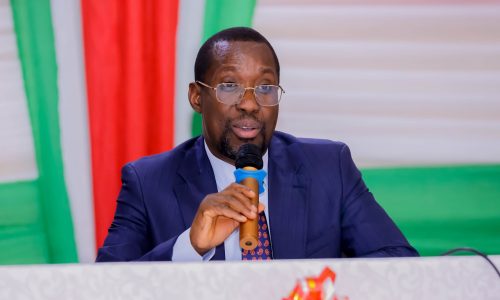
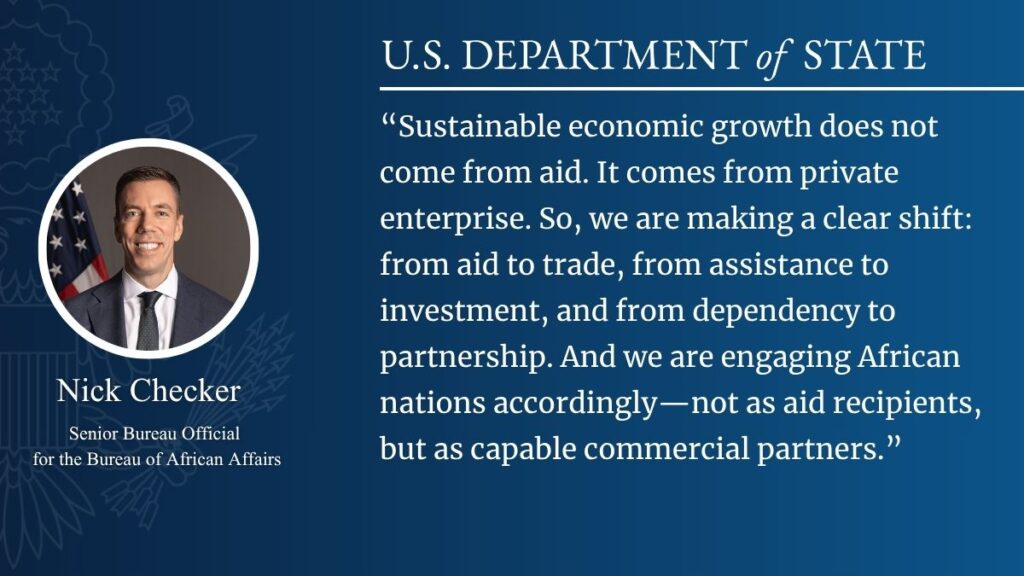
Speaking at the Center for Strategic and International Studies (CSIS), Nick Checker, Senior Bureau Official for African Affairs, said the Trump administration is pursuing what he called a “fundamental reset” in U.S. development strategy—moving away from aid volumes and program counts toward measurable economic outcomes.
“This is not incremental reform,” Checker said. “We are entering a new era defined not by aid flows, but by economic growth, and not by dependency, but by mutually beneficial partnerships.”
The announcement reflects a sharp critique of the traditional aid model. According to Checker, the United States has invested more than $200 billion in African assistance since 1991, yet structural challenges persist across many economies, including limited industrialization, weak export diversification, and ongoing reliance on external financing.
He argued that the issue is not underfunding but a flawed system that prioritized spending over results. “We measured success by dollars spent and programs launched rather than economies transformed,” he said, adding that this approach often created dependency and failed to generate long-term development.
Citing examples such as South Sudan—where more than $9.5 billion in U.S. assistance has coincided with ongoing instability—Checker said the current system can unintentionally weaken governance by reducing accountability. He also noted inefficiencies within what he described as a sprawling “NGO industrial complex,” where large portions of funding are absorbed before reaching intended beneficiaries.
A central pillar of the new strategy is a shift from aid to trade. Checker emphasized that sustainable development is driven by private enterprise, not external assistance. “Growth comes from investment, infrastructure, production, and value creation—not aid dependency,” he said.
Under the revised approach, African countries will be treated less as aid recipients and more as commercial partners. The U.S. will prioritize markets where American strategic and economic interests align with African growth ambitions. This includes a stronger focus on commercial diplomacy, where embassies are tasked with supporting trade deals and investment opportunities.
“The question is no longer how much aid we deliver, but how many deals we help close,” Checker said.
The policy also highlights Africa’s growing global importance. With a projected population of 2.5 billion by 2050 and estimated purchasing power of $16 trillion, Checker described the continent as a future engine of global growth. Despite this, he noted that U.S. exports to sub-Saharan Africa remain under 1 percent of total trade.
To address this gap, the U.S. will expand market reforms, infrastructure partnerships, and private sector engagement. Ambassadors will now be evaluated based on their ability to facilitate commercial outcomes, while diplomatic missions will increasingly include American companies in trade missions and negotiations.
A key area of focus is critical minerals, including cobalt, copper, and rare earth elements, which are essential for global technology and energy transitions. The U.S. strategy aims to secure supply chains while promoting transparency and local value creation. A recent partnership agreement with the Democratic Republic of Congo was cited as a model for this approach.
“We are not pursuing extraction; we are pursuing value creation,” Checker said, stressing that future investments must include job creation, skills transfer, and industrial development within African economies.
The strategy also links economic cooperation to regional stability, particularly in conflict-prone areas such as the Great Lakes region. New frameworks are being developed to tie peacebuilding efforts to cross-border trade and shared economic incentives between countries like Rwanda and the DRC.
While reaffirming that foreign assistance will continue, Checker stressed that it will be significantly restructured. Aid will now be “targeted, conditional, time-bound, and results-based,” with a stronger emphasis on performance and accountability.
“We will no longer fund programs indefinitely without outcomes,” he said. “Countries that demonstrate reform will see deeper partnership. Those that do not will not.”
The new model, he concluded, is designed to make aid less necessary over time by strengthening self-reliance while advancing U.S. strategic and commercial interests.
“Our goal is not to sustain aid dependence in Africa,” Checker said. “It is to make it unnecessary.”
The policy shift marks one of the most significant changes in U.S.–Africa relations in decades, signaling a future shaped less by development assistance and more by market-driven engagement.