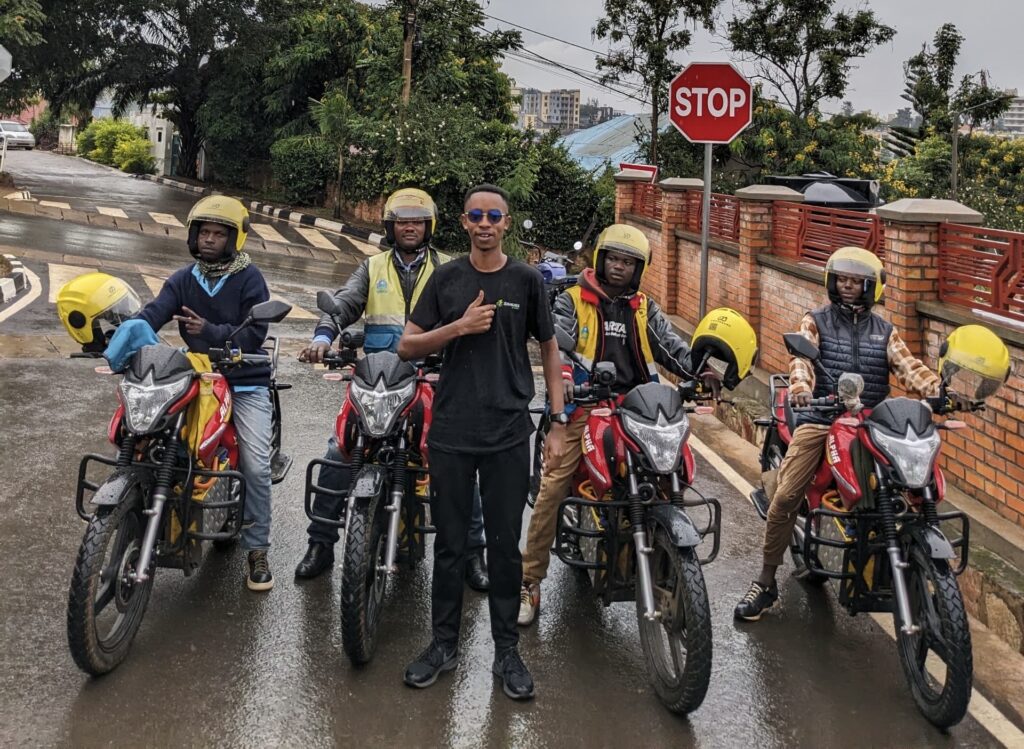
As Rwanda accelerates its transition to clean transport, a young entrepreneur is turning policy change into economic opportunity. Remy Mico, a Rwandan innovator and founder of ZAMUKA RIDEZ, is helping young riders access electric motorcycles with no upfront cost—transforming livelihoods while advancing his country’s green mobility agenda.
Born and raised in Rwanda, Remy describes himself in two words: agile and hardworking. With a background in sciences—physics, chemistry and biology—he developed an early fascination with mechanics and motion. “Physics helped me understand how things work, especially in mechanics and velocity. It gave me confidence to learn anything I set my mind to,” he explains.
But his entrepreneurial journey started much earlier. At just nine years old, he accompanied his mother to her shop, learning how to deal with customers of different personalities and understanding the value of discipline and consistency. That early exposure planted the seed for what would later become a mission-driven enterprise.
Today, that mission is closely aligned with Rwanda’s bold environmental policies. The Government of Rwanda has prohibited the importation of petrol-powered motorcycles, promoting electric alternatives as part of a broader strategy to modernize transport and reduce emissions. While the policy has opened a new chapter for sustainable mobility, it has also created a challenge: many young people with motorcycle licenses cannot afford electric bikes, and existing riders struggle to transition from fuel-powered models.
Remy saw the gap—and moved to close it. He founded ZAMUKA RIDEZ, a name derived from the Kinyarwanda word “Zamuka,” meaning “upgrade.” The concept is simple but transformative: provide electric motorcycles to qualified young riders at no upfront cost. Riders operate under a rental model with daily deposits, and after 12 months, they can enter a ride-to-own program to fully acquire the motorcycle. “The idea was to help riders upgrade—from zero ownership and unstable income to steady earnings and asset ownership,” Remy says.
The model is already delivering results. Riders deposit approximately 7,000 Rwandan Francs per day, drawn from average daily revenues ranging between 14,000 and 25,000 Rwandan Francs. Unlike petrol motorcycles, electric bikes eliminate fuel and lubricant costs, allowing riders to save more. Several riders from rural areas have relocated to Kigali, Rwanda’s capital, thanks to improved incomes. Three are married with children and now able to support their families sustainably.
For Remy, transportation is more than movement—it is growth. “There is no improvement without movement—of goods, people or technology,” he notes. “Being part of sustainable transport is fulfilling because it drives economic progress while protecting the environment.”
ZAMUKA RIDEZ’s growth strategy is designed for scale. The company operates on a daily payment model, enabling incremental fleet expansion—adding new motorcycles from revenues generated by existing ones. As electric mobility expands beyond Kigali into all 30 districts of Rwanda, the market opportunity continues to widen, particularly in peri-urban areas where affordability remains a barrier.
Remy credits part of his business discipline to his participation in the Young African Leaders Initiative (YALI) entrepreneurship and business track in 2023. The practical training sharpened his leadership approach and strengthened his ability to identify underlying problems and design sustainable solutions. Additionally, an incubation program through INKOMOKO placed him among the top 60 entrepreneurs in East Africa, providing mentorship and technical training tailored to Rwanda’s regulatory and tax environment.
One key mentor, Henry Nyakarundi of ARED Group, remains on his advisory team, helping refine strategy and navigate growth challenges. “Mentorship is a game changer,” Remy emphasizes. “It teaches you when to focus and when to pivot.”
Like many startups, ZAMUKA RIDEZ faces capital constraints. Expanding the fleet and hiring additional staff require investment. Yet the blueprint for the ride-to-own model is ready. By the end of this year, the company plans to double its fleet, with four riders entering the ownership track.
Despite being Managing Director, Remy is quick to highlight the riders as the backbone of the company. “They are on the frontline. Their success is our success,” he says.
ZAMUKA RIDEZ positions itself not merely as a transport provider but as a platform for economic empowerment, cleaner cities and a sustainable future. Its long-term vision is ambitious: to become Africa’s leading eco-friendly motorcycle transport service provider.