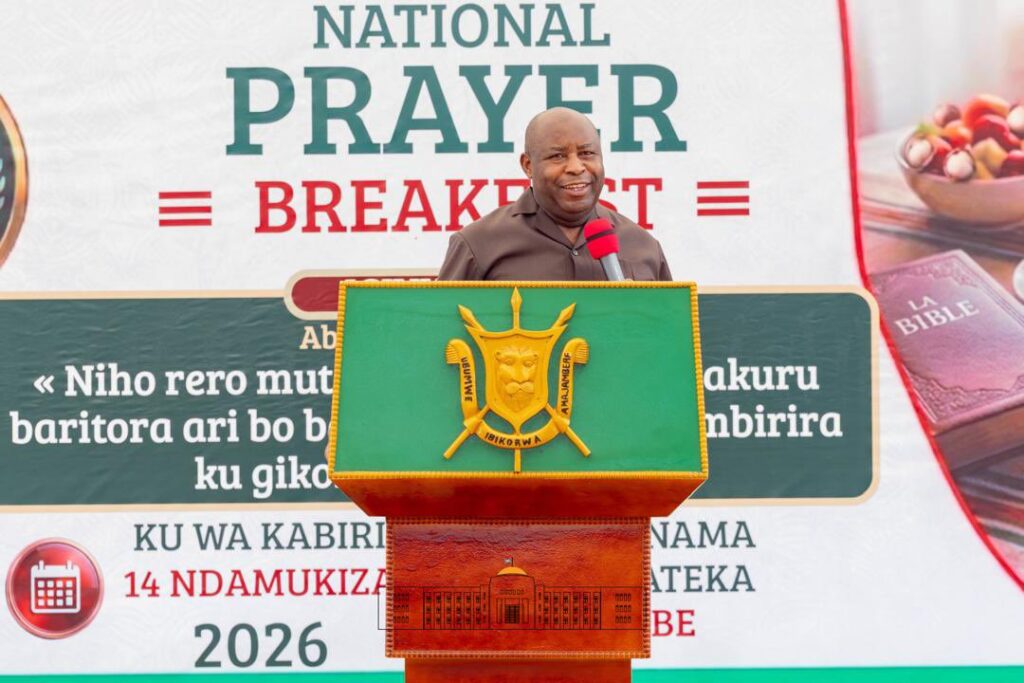
Burundi’s top leaders gathered on April 14, 2026, at the Congress Hall in Kigobe, Bujumbura, for the 17th edition of the National Prayer Breakfast, an annual high-level spiritual and civic event that this year focused on fiscal responsibility and leadership accountability. Placed under the biblical theme drawn from Romans 13:6 — “This is also why you pay taxes, for the authorities are God’s servants, who give their full time to governing” — the meeting brought together President Evariste Ndayishimiye, senior state officials, religious leaders, and institutional representatives in a call for integrity in governance and voluntary tax compliance.
Beyond prayer, the event evolved into a forum for reflection on the relationship between faith, leadership, and public finance. Speakers emphasized that tax payment is not only a legal requirement but also a moral duty, while insisting that leaders must ensure transparency and accountability in the management of public resources. The gathering also revisited the origins of the National Prayer Breakfast, launched in the United States in the 1930s by pastor Abraham Vereide and institutionalized nationally in 1953, before spreading to other countries, including Burundi, which adopted it in 2006.
Participants highlighted that the initiative aims to bring leaders together for prayer, dialogue, and national reflection. This year’s edition placed particular emphasis on fiscal civism, with authorities encouraging citizens to pay taxes voluntarily while also urging institutions to strengthen trust through fair governance.
Taxes as a biblical duty and governance test
The day’s sermon by Father Désiré Yamuremye centered on the moral dimension of taxation and leadership responsibility. He stressed that paying taxes is a duty rooted in both law and faith, while warning that authorities must ensure those taxes serve the population.
“Citizens are called to pay taxes, but authorities must ensure that those taxes are used for the common good,” he said, urging leaders to demonstrate integrity in public service. He further emphasized that trust between taxpayers and institutions is essential for voluntary compliance.
Referring to cases of tax evasion and institutional responsibility, he raised concerns about leadership accountability. “If a taxpayer extracts minerals and exports them without paying taxes, through which channels does that happen? Are there no institutions?” he asked, pointing to systemic weaknesses that undermine fiscal discipline.
He also rejected a culture of opportunism in which individuals prioritize personal gain over national responsibility, calling for ethical leadership. According to him, respect for authority must be accompanied by justice and transparency. The priest concluded that leaders must play their role in encouraging tax compliance by managing resources responsibly and serving citizens effectively.
“Not all authority comes from God”: a debate on leadership accountability
The panel discussion that followed, moderated by Secretary-General of the State Jérôme Niyonzima and featuring former President Domitien Ndayizeye and former Senate President Emmanuel Sinzohagera, introduced a more critical perspective on authority and governance.
Ndayizeye cautioned against interpreting biblical teachings in a way that automatically legitimizes political power. “Ivyo kwubaha abaganza, kuko ata kuganza kutava ku mana ni kubigendako gahorogahoro. Hari abaganza batari abakozi b’Imana. Ibuka Micombero ayo yadukoreye … Twovuga ngo yari umukozi w’Imana?” he said, questioning whether all leaders can be considered servants of God.
He insisted that leadership legitimacy depends on service to citizens. “Nimba abaganza batari butunganirize neza abo baganza… uwo nta bukozi bw’Imana, ni ‘direct’ mu muriro,” he added, warning that leaders who divide citizens fail their mission.
Sinzohagera emphasized the need for leaders to set an example, especially regarding tax compliance. “Kuba abakuru bagonanwa gutanga ikori, mukubwira abandi ko batanga ikori ngo vyokunda hamwe wosanga bovuga bati: ‘Murabe ivyo mvuga, ntimurabe ivyo nkora’,” he said, warning against hypocrisy in leadership.
The discussion also acknowledged corruption and irregularities in tax collection. Ndayizeye admitted that such practices exist but stressed that the state must address them. “Ngaha si mw’ijuru… Ariko Reta ihari kugira igorore utwo twose,” he noted, calling for stronger oversight and fair tax administration.
Toward voluntary tax compliance and national development
Speakers also addressed economic challenges related to taxation, urging authorities to balance revenue mobilization with citizens’ capacity to pay. Both Ndayizeye and Sinzohagera emphasized that excessive taxes could discourage compliance and hinder economic activity.
They called for modernization of tax collection systems, including digitalization, to ensure transparency and prevent funds from being diverted. Participants also recommended stricter enforcement against individuals benefiting from immunity or political protection while avoiding taxes.
President Evariste Ndayishimiye, addressing participants, linked fiscal responsibility to Burundi’s long-term development ambitions. He urged citizens to pay taxes willingly and leaders to embody accountability in their service.
He emphasized that achieving the country’s Vision 2040 and 2060 requires a culture of responsibility and productivity. “Umwenegihugu wese ni atange ikori atagahato… Gutanga ikori ni iteka, si itegeko gusa,” he said, encouraging voluntary compliance.
The president also called on Burundians to invest in productive activities to expand the tax base and strengthen national development. According to him, leadership accountability and citizens’ participation remain essential for economic progress.
As the 17th National Prayer Breakfast concluded, the message resonated clearly: taxation, governance, and faith are intertwined. Leaders are expected to serve with integrity, citizens are encouraged to contribute willingly, and institutions must build trust through transparency. The event ultimately underscored that Burundi’s development ambitions depend not only on policy reforms but also on ethical leadership and shared national responsibility.