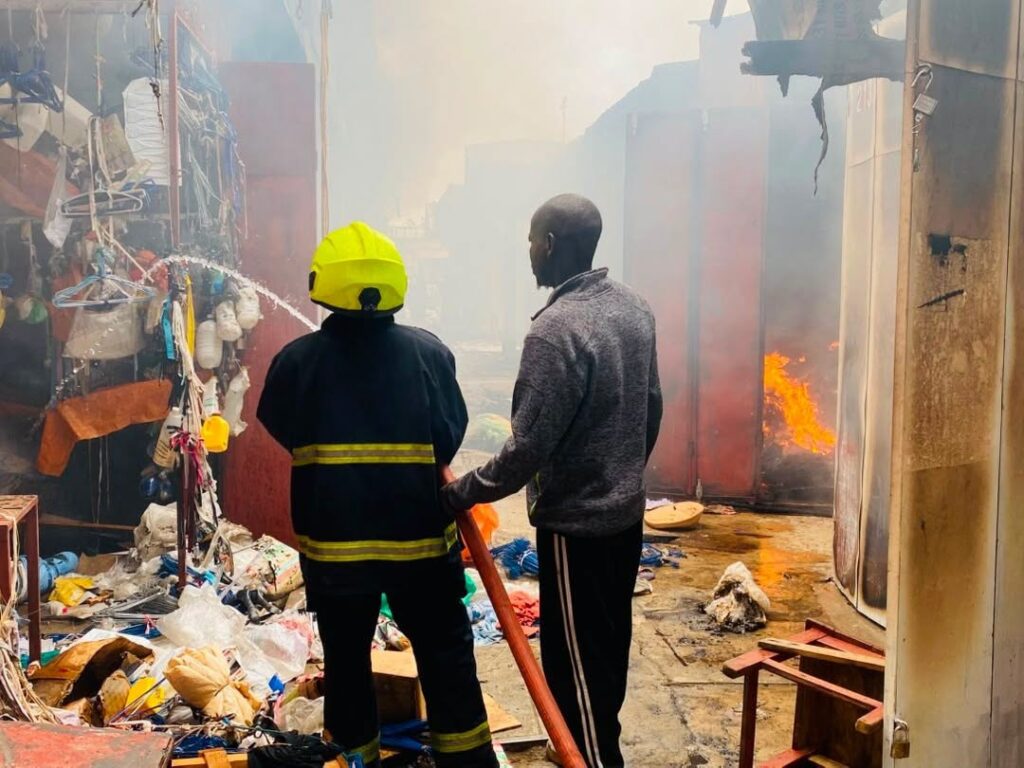
A fire broke out at Kinindo Market in southern Bujumbura at around 10 a.m. on Tuesday, August 25, 2026, sending traders scrambling to rescue their merchandise as flames spread through parts of the market along Avenue du Large.
The fire is believed to have started in the section where mattresses are sold. Traders rushed to remove goods that had not yet been reached by the flames, while firefighters worked to contain the blaze.
Their efforts were complicated by limited access to some parts of the market, allowing the fire to spread to additional areas before it was brought under control.
Several minutes after the fire started, Dr. Alain Ndikumana, Burundi’s minister of finance, arrived at the scene alongside police officers from emergency response services. By then, the section where mattresses were sold had already suffered extensive damage.

Speaking at the scene after firefighters brought the blaze under control, Ndikumana urged caution over speculation about its cause.
“We should not rush to say what caused the fire. We do not yet know what caused this fire. Investigations have already started here.”
The minister said the full scale of the losses would be established once authorities completed their assessment.
He also sought to reassure traders who lost their goods, saying the government was closely monitoring the situation and would announce measures aimed at preventing similar disasters.
Ndikumana added that authorities would examine how to address the situation of affected traders, including possible government support for those whose businesses and merchandise were destroyed.
By around midday, the fire appeared to have been brought under control. Police responsible for emergency response and investigators cleared people from the affected area to allow investigations to begin.
The mood among traders was sombre. Those who managed to save some of their belongings watched anxiously, while traders whose stalls were destroyed stood among the ruins. Many were visibly overwhelmed, with some breaking down in tears.
The cause of the fire and the full extent of the financial losses remain under investigation.
Another Market Fire, Just Four Days After Bujumbura Blazes
The Kinindo fire comes just four days after a major blaze destroyed Galerie Ndayizamba and Le Parisien in central Bujumbura on August 21.
The two incidents in less than a week have renewed concerns over fire safety, emergency access and the capacity to respond rapidly to fires in the city’s densely packed commercial areas.
But Kinindo is not an isolated case.
The latest incident adds to a long and troubling history of market and commercial fires across Burundi — a pattern that has repeatedly left traders facing the destruction of merchandise, businesses and livelihoods.
A History of Fires That Stretches Back Decades
In September 2001, Gitega Market was hit by a devastating fire. In December 2010, Mutaho Market burned.
The fires continued in 2011, when the markets of Kayogoro, Bururi and Nyanza-Lac were destroyed by fire.
During the night of January 1–2, 2012, Kamenge Market caught fire. Ngozi Market would later experience fires on four separate occasions, highlighting the recurring vulnerability of commercial centers.
Other incidents followed.
Rushubi Market was affected in 2012, while Bujumbura’s central market burned in 2013. Kayanza Market was hit in 2014, followed by the T2000 Super Market in 2015 and Ruvumera Market in Buyenzi in 2017 and in May 2024.
Kamenge Market was again affected by fire in October 2020.
In December 2021, a fire struck Gitega central prison, followed by Galerie Mandela in 2022.
The incidents continued on night of Sunday, September 15, 2024, when fire destroyed the small market and carpentry workshops of North Mutanga. Galerie Diko, in downtonw, suffered a fire on February 19, 2025.
2026: A Particularly Difficult Year
The frequency of reported fires has become particularly striking in 2026.
On January 26, a destructive fire broke out at the timber and lumber trading section (known as “Ku Mbaho“) behind the widely known as Bujumbura City Market or Kwa Siyoni. Kinama Market was hit on May 7, while Ruhwa Market in Cibitoke (often broadly referred to by locals as the market of “Cibitoke ca Rugombo”) was affected on May 29.
Other incidents followed at Ngozi Market on July 9–10 and Jabe Market on July 22.
A fire was also reported at a military facility on March 31. It caused a series of powerful explosions at the main logistics brigade ammunition depot of the Burundi National Defence Force in Musaga, Bujumbura, killed at least 13 people and injured 57 others, as reported by Africa Defense Force
Then, on August 21, Galerie Ndayizamba and Le Parisien in downtown Bujumbura were devastated by fire.
Four days later, Kinindo Market became the latest commercial site to be hit.
Taken together, the incidents documented so far make 2026 one of the most concerning years in recent memory for fires affecting markets and commercial facilities in Burundi.
The pattern has also raised broader questions: Why do fires continue to cause such extensive damage? Are markets sufficiently equipped with fire-prevention systems? Can emergency services reach affected areas quickly enough? And what mechanisms exist to protect traders from catastrophic losses?
Traders Left to Rebuild
For traders at Kinindo, those questions are more than matters of public policy.
They are about livelihoods.
As flames consumed stalls on Tuesday, traders rushed into danger to save whatever they could carry. Some managed to recover part of their merchandise. Others watched helplessly as their businesses were destroyed.
The emotional scenes at Kinindo echoed those witnessed at other markets hit by fire across Burundi over the years.
For many traders, a market stall represents years of investment and a family’s primary source of income. When a fire destroys it in minutes, rebuilding can take years — if it is possible at all.
The government has indicated that it will assess the damage and consider measures to assist affected traders. But the immediate priority remains determining what caused the Kinindo fire and establishing the full extent of the losses.
Investigations Underway
Authorities have not yet identified the cause of the Kinindo Market fire.
Investigators are expected to examine where the blaze started, how it spread and whether factors such as electrical systems, the market’s layout, access for emergency vehicles or the availability of firefighting equipment played a role.
Until those investigations are completed, officials have urged the public not to draw premature conclusions.
What is already clear, however, is that Kinindo has become the latest entry in a long record of fires that have repeatedly struck Burundi’s markets.
And as traders begin the difficult task of counting what was saved — and what was lost — the latest blaze is once again putting fire safety and emergency preparedness in Burundi’s commercial centers under the spotlight.