.The three-day meeting will examine how digital tools can simplify tax compliance, strengthen public revenue collection and support economic development.
The Order of Accounting Professionals of Burundi (OPC) will hold its 11th congress from December 2 to 4, bringing together accounting professionals, government representatives, business leaders and other stakeholders to discuss the role of digital taxation in the country’s economic development.
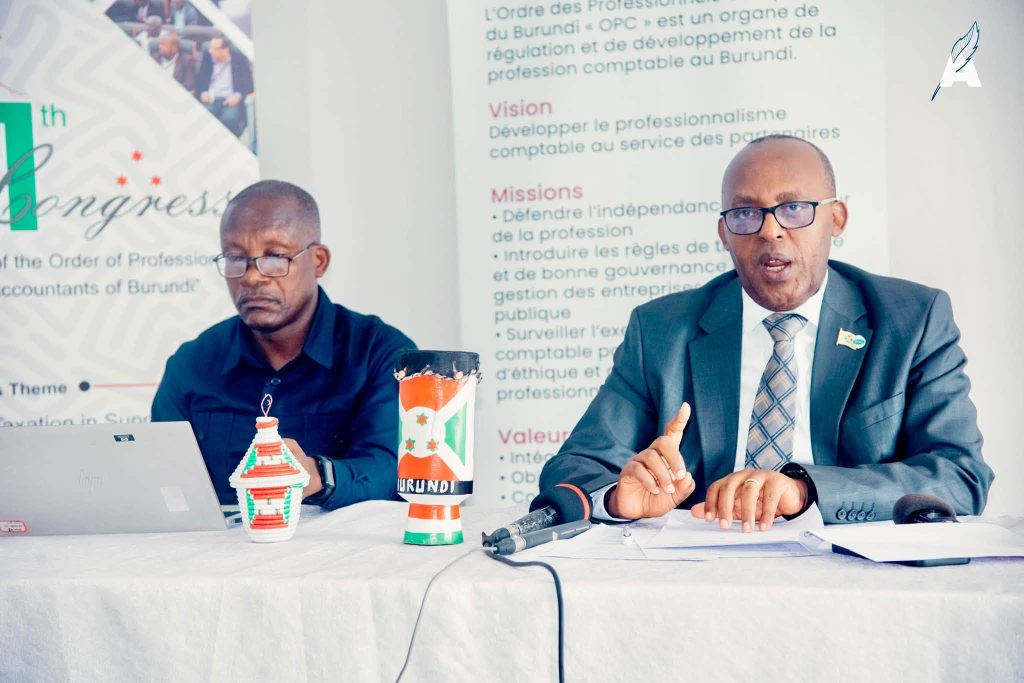
The announcement was made on November 26, 2026, during a press briefing at the OPC headquarters in Bujumbura. CPA Frédéric Gahungu, accompanied by the organization’s executive secretary, Silas Magayane, outlined the objectives of the forthcoming congress.
Held under the theme “Digital Taxation in Service of Burundi’s Vision 2040–2060,” the congress will examine how technology can modernize tax administration and contribute to the country’s long-term development ambitions.
Digital taxation involves using technology to simplify tax declarations and payments, improve the management of tax obligations and facilitate communication between taxpayers and the tax administration.
The OPC says that when implemented in an accessible, secure and transparent manner, digital systems can make taxation more efficient and easier to understand.
For businesses and financial institutions, such tools can reduce administrative burdens, improve accounting practices and facilitate compliance with tax obligations. They can also allow business owners to devote more time to their operations.
At the national level, modernizing tax services could help improve public revenue collection, expand access to services and strengthen transparency. The resulting revenues could contribute to financing national priorities, while a more predictable tax environment could encourage investment, entrepreneurship and the formalization of economic activity.
Accountants’ role in digital transformation
Gahungu emphasized the role of accounting professionals in supporting the transition toward digital financial systems, particularly as electronic invoicing and online payments become increasingly important.
“As the decree indicates, we are partners. We are in the middle, and we are neutral,” Gahungu said during the briefing, highlighting the profession’s position in supporting businesses and public institutions.
He added that electronic invoicing and online payments could simplify financial transactions and make it easier for taxpayers to fulfill their obligations.
The congress will also address the practical challenges associated with digital taxation, including unreliable electricity supplies, internet connectivity, data protection and the security of digital systems.
Participants are expected to discuss how businesses, particularly small and medium-sized enterprises, can receive the training and technical support needed to adopt digital accounting and taxation tools.
The OPC says the accounting profession works with the government to strengthen the legal and regulatory framework through the expertise of its members. It also recognizes that digitalization cannot be fully effective without reliable electricity and internet access.
According to the organization, the government has already begun taking these challenges into account through initiatives related to electronic invoicing.
The three-day congress is expected to provide a platform for exchanging experiences and identifying practical solutions that can help Burundi build a more accessible, transparent and efficient tax system.