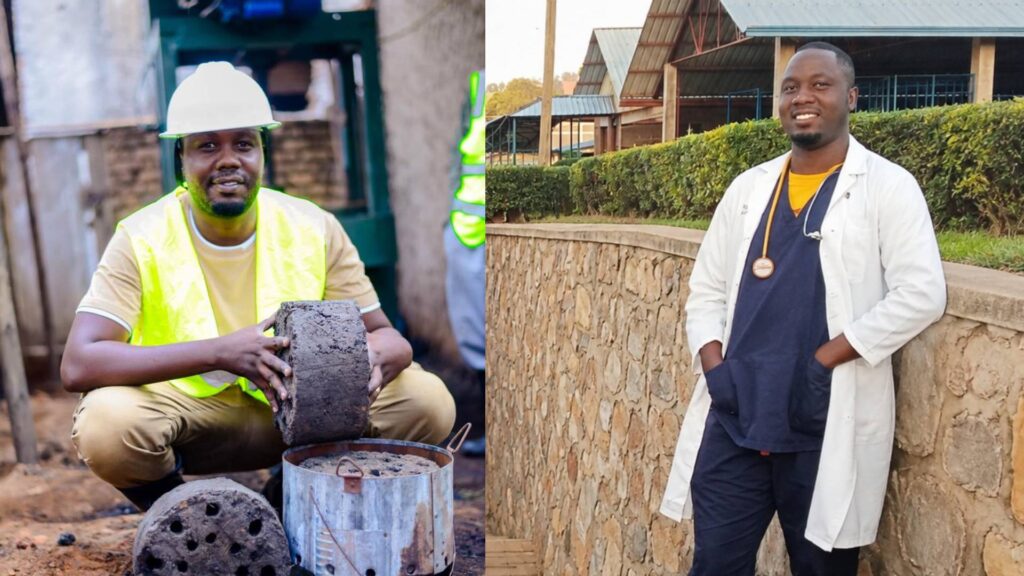
When Dr. Juste Niragira looks at agricultural waste, he sees more than discarded plant material. He sees an opportunity to protect the environment, create jobs and help families reduce the cost of cooking.
A trained medical doctor with a specialization in gynecology and obstetrics, Niragira has taken an unconventional path beyond the hospital. He is the founder and chief executive of Janico Bio Company, a Burundian enterprise that produces eco-friendly charcoal from agricultural and other plant-based waste.
His ambition is to address two challenges at once: the cutting down of trees to produce traditional charcoal and the growing problem of agricultural waste that is often burned or thrown away.
“I wanted to find solutions to the problems associated with cutting down trees for charcoal production and the disposal of agricultural waste,” Niragira said, explaining the idea behind his business.
Founded on November 24, 2022, Janico Bio Company emerged from an idea he developed while studying in China. There, he observed how discarded materials could be transformed into useful products, inspiring him to explore how a similar approach could work in Burundi.
From the medical field to environmental entrepreneurship
Niragira was born in Bujumbura town. He graduated from Hope Africa University in 2018 before pursuing further studies in gynecology and obstetrics at Shandong University in China, completing his training in 2023.
Although his education prepared him for a career in medicine, he became increasingly interested in the connection between environmental protection and human health.
Deforestation, smoke from cooking fuels and environmental degradation can all affect people’s well-being. For Niragira, finding alternatives to conventional charcoal was therefore not simply a business opportunity; it was also a way to contribute to sustainable development.
His company follows the principles of a circular economy, in which materials that would otherwise be discarded are given a second life as useful products.
Rather than relying primarily on wood harvested for charcoal production, Janico Bio Company uses agricultural residues and other plant-based waste available locally.
The idea is straightforward: turn a waste-management problem into an economic opportunity while offering consumers an alternative source of cooking fuel.
An alternative to traditional charcoal
Janico Bio Company sells its products in two main formats, targeting households as well as businesses that depend on charcoal for daily operations.
Its larger charcoal product weighs 3.5 kilograms, costs 3,000 Burundian francs and can burn for up to six hours, according to Niragira. It is marketed to restaurants, butcher shops, bakeries and other commercial users.
The company also sells charcoal in 10-kilogram bags for 12,000 francs, equivalent to 1,200 francs per kilogram.
The fuel is designed to be used with specially made stoves to improve its performance.
Niragira says customers can spend between 3,000 and 5,000 francs a day using his company’s charcoal, compared with an estimated 8,000 to 10,000 francs for traditional wood charcoal.
That could translate into daily savings of between 3,000 and 7,000 francs, depending on consumption and how customers use the fuel.
For a customer who reduces daily spending from 10,000 to 5,000 francs, the savings would amount to 150,000 francs over 30 days.
These figures are estimates provided by the entrepreneur; actual savings will depend on cooking habits, fuel efficiency and local prices.
The company also says its charcoal can burn for longer periods and produce less smoke when used with the appropriate stove. Its environmental and cost benefits, however, will ultimately depend on the production process, the source of the raw materials and the way the fuel is used.
Building a business from limited resources
Turning an idea into a functioning enterprise has not been easy.
Niragira says the early days required courage, patience and a willingness to learn how to manage limited resources. Like many entrepreneurs, he had to develop the business gradually while learning how to produce the fuel and attract customers.
He also believes that capital should not be understood solely in financial terms.
“Knowledge, time, the people you can work with, the trust customers place in you and the ability to solve problems are also forms of wealth,” he said.
The company began on a small scale, but its production has gradually increased. Niragira says he hopes to triple output when the business secures the equipment and resources it needs.
For now, Janico Bio Company employs six people. Its activities also create indirect opportunities for others involved in supplying raw materials, transporting products and selling the finished fuel.
For Niragira, employment creation is both a source of satisfaction and a responsibility. Leading a team, he says, requires patience, listening and the ability to make sound decisions.
A wider ambition for Burundi
The entrepreneur’s vision extends beyond increasing production.
Over the next five years, he hopes to equip Janico Bio Company with more advanced machinery, expand its reach across Burundi and eventually enter markets beyond the country.
He also wants the business to create more jobs for young people, reduce pressure on forests and make affordable cooking alternatives available to more households.
The challenge will be turning that ambition into a business that can scale sustainably. Access to equipment, financing, reliable supplies of agricultural waste and a broader customer base will all be important to the company’s next phase of growth.
Still, Niragira believes young Burundians should not wait until they have all the resources they need before pursuing an idea.
His advice is to identify a real problem, understand the people affected by it, plan carefully and begin with what is available.
“Do not be afraid to start, even with a small amount of capital,” he said. “Do not wait until you have everything before you begin. Start with what you have, grow step by step and keep your goal in sight.”
Niragira’s entrepreneurial journey has not replaced his professional identity as a doctor. Instead, he sees environmental entrepreneurship as another way to contribute to people’s well-being.
He is also a husband and father of two, and says his family is an important source of encouragement.