At the close of the first day of the Africa Forward Summit in Nairobi, French President Emmanuel Macron announced a €23 billion investment package aimed at accelerating Africa’s economic transformation — a move he described as a shift from traditional aid to “partnership through investment.”
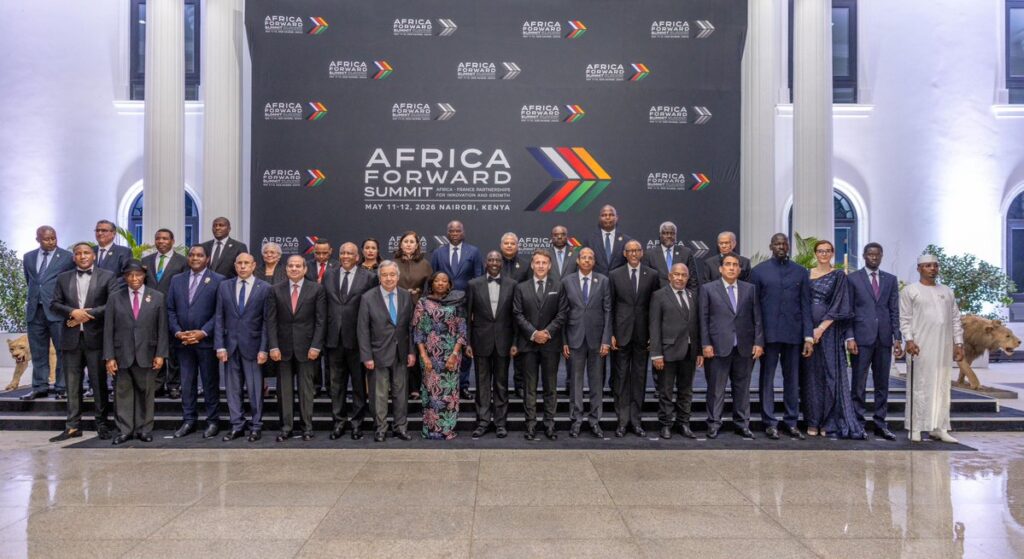
Held at the Kenyatta International Convention Centre, the summit brought together more than 20 African heads of state, global financiers, development institutions, and business leaders in what Kenyan President William Ruto called “a defining moment for Africa’s future.”
Unlike past development pledges often tied to public aid, Macron emphasized that the new funding would largely come from private-sector capital, signaling what France says is a recalibration of its relationship with Africa.
“Partnerships of the future cannot be built on dependence,” Macron told delegates. “They must be grounded in co-investment, sovereign equality, and shared prosperity.”
From Aid to Investment
According to the French president, €14 billion of the package will come from French public and private companies, while the remaining funds are expected to be mobilized through African investors and financial institutions.
The investments will target strategic sectors seen as central to Africa’s next phase of growth: electricity, artificial intelligence and digital innovation, green industrialisation, agriculture, healthcare, manufacturing, and banking.
The announcement reflects a broader geopolitical and economic repositioning by France in Africa at a time when several African nations are increasingly demanding relationships based on mutual benefit rather than dependency.
For decades, France’s influence on the continent was heavily associated with aid, military cooperation, and political alliances. But rising competition from countries such as China, Turkey, the Gulf states, and Russia — combined with growing African calls for economic sovereignty — has pushed Paris to redefine its engagement.
In Nairobi, Macron acknowledged that the old model no longer fits today’s Africa.
Africa’s Message: “We Are Ready to Lead”
Standing alongside Macron during the summit’s closing ceremony, President Ruto delivered a message aimed as much at global investors as at African governments themselves.
“Africa is not waiting to be invited to the future,” Ruto declared. “Africa is building that future now together with friends and partners.”
The Kenyan leader repeatedly stressed that the continent’s transformation would depend not only on foreign capital, but also on African leadership, policy reforms, and domestic resource mobilization.
Ruto called on African governments to remove bureaucratic barriers slowing industrial projects and renewable energy investments. He urged financiers to make capital more accessible and businesses to provide clear long-term investment commitments.
The summit placed particular emphasis on green industrialization and energy transition — sectors many African governments see as an opportunity for the continent to industrialize while responding to climate pressures.
Africa holds some of the world’s largest reserves of critical minerals essential for electric batteries and renewable technologies. Leaders at the summit argued that the continent must move beyond exporting raw materials and instead build value-added industries locally.
A High-Level Gathering
The Africa Forward Summit drew an unusually large gathering of African leaders and international officials.
Among those attending were Presidents Paul Kagame, Alassane Ouattara, Abdel Fattah el-Sisi, Bassirou Diomaye Faye, Bola Ahmed Tinubu and John Dramani Mahama.
Also present were Antonio Guterres and senior representatives from the African Union, multilateral lenders, and development agencies.
Discussions focused on reforming the international financial system, infrastructure connectivity, youth employment, artificial intelligence, and climate financing.
Behind the diplomatic language, however, lay a larger debate: whether Africa can secure fairer terms in the global economy while maintaining control over its resources and development priorities.
Opportunities — and Questions
The €23 billion announcement has already generated optimism among some investors and policymakers who see it as evidence of renewed confidence in Africa’s economic potential.
But analysts say the success of the initiative will depend on implementation, transparency, and whether the promised investments materialise beyond summit declarations.
There are also questions about how benefits will be distributed across African economies already burdened by debt, unemployment, and climate vulnerability.
Still, the symbolism of the Nairobi summit was difficult to ignore.
In a world marked by geopolitical fragmentation and economic uncertainty, African leaders used the platform to project a continent seeking not charity, but influence — and partnerships on equal footing.
From Nairobi, the message was clear: Africa no longer wants to be viewed as the frontier of crisis, but as a central player in shaping the global economy of the future.