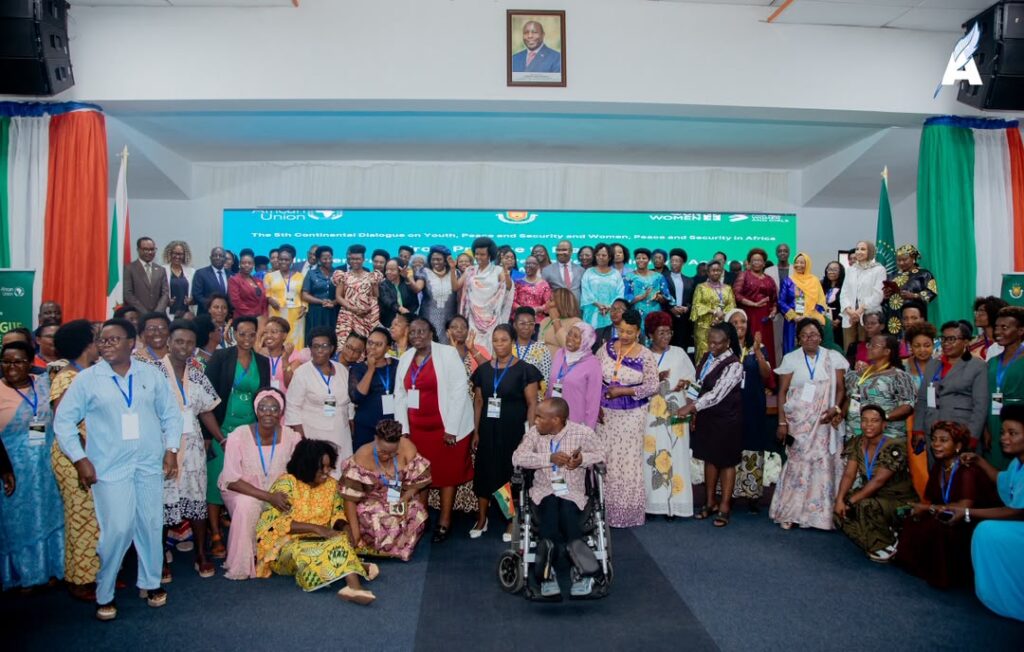
Calls for action, accountability, and stronger leadership from young people and women dominated the second day of the 5th Continental Dialogue on Youth, Peace and Security and Women, Peace and Security in Africa, held Tuesday August 11, 2026 in Bujumbura, Burundi’s economic capital.
The gathering, which brought together policymakers, youth leaders, civil society representatives, and African Union officials, focused on translating commitments into tangible outcomes for peacebuilding, conflict prevention, and sustainable development across the continent.
Held under the theme “Water, Peace and Inclusive Leadership in Africa: Institutionalizing the Strategic Role of Youth and Women in Conflict Prevention, Risk Management and Sustainable Peacebuilding Through Responsible Resource Governance,” the day featured four parallel sessions at Donatus Conference Center and Club du Lac Tanganyika.
Participants examined key issues ranging from youth engagement in peacebuilding to women’s leadership, water governance, and access to justice.
One session centered on the African Union’s “Silencing the Guns” initiative, providing a platform for young people to discuss their role in preventing conflict and promoting a culture of peace. Another marked the 20th anniversary of the African Youth Charter, assessing progress made and the challenges that remain in turning policy commitments into concrete opportunities in employment, education, entrepreneurship, civic participation, and leadership.
Discussions also highlighted the growing link between water security and peace. Delegates stressed that equitable access to water resources is increasingly tied to community stability and conflict prevention, while calling for greater inclusion of young people and women in resource governance and decision-making.
A fourth session focused on women’s leadership in peace negotiations and access to justice, with speakers urging African institutions to strengthen women’s representation in mediation, peace processes, and governance structures.
Among the day’s prominent voices was Professor Désiré Manirakiza, Coordinator of Burundi’s Youth Economic Empowerment and Employment Program (PAEEJ) and Vice Chair of the African Peer Review Mechanism Panel. He challenged both young Africans and policymakers to rethink their approach to youth participation.
“Young people should not view their future as something that will simply happen tomorrow,” Manirakiza said. “They must take ownership of it and position themselves as active agents of Africa’s development.”
He urged youth not to remain passive observers of political discourse but to claim their place in shaping the continent’s future.
“You are not puppets; you are actors,” he told participants, emphasizing that meaningful change requires action rather than applause.
Manirakiza also called for stronger data-driven policymaking. He proposed the creation of a digital platform capable of collecting real-time information on the concerns, aspirations, and challenges facing young Africans, arguing that governments need more representative data to design effective youth-focused policies.
Burundi’s Minister of Youth, Sports and Culture, Lydia Nsekera, delivered a message centered on responsibility, perseverance, and hope. She encouraged participants to leave the conference with clear objectives and a commitment to work toward them with discipline and patience.
Nsekera urged young Africans to embrace mentorship, acquire new skills, and learn from setbacks rather than fear them. She also emphasized the importance of integrity, accountability, respect, friendship, and excellence as foundations for future leadership.
The minister encouraged young people to build cooperatives, strengthen networks, and create platforms for dialogue while respecting their communities, families, health, and environment, particularly water resources.
“These values can help build a generation of champions capable of creating a strong, prosperous, and developed Africa,” she said.
Liberata Mulamula, the African Union Special Envoy for Women, Peace and Security, warned that Africa risks repeating the same conversations if commitments are not backed by implementation.
She said discussions on youth, women, water, peace, justice, and leadership must move beyond declarations and be accompanied by concrete action plans, implementation mechanisms, and systems for monitoring results.
Burundi’s First Lady, Angeline Ndayishimiye, welcomed African delegations and partner organizations, placing particular emphasis on women’s leadership and participation in decision-making.
She called for the removal of barriers that limit women’s involvement in leadership positions and advocated for stronger mentorship programs and experience-sharing initiatives.
The First Lady also underscored the importance of equitable access to justice, arguing that lasting peace cannot be achieved without legal systems capable of protecting women’s rights, combating discrimination, and ensuring that no one is excluded from peacebuilding processes.
By the end of the day, several common priorities had emerged: increasing the effective participation of youth and women in peace and governance structures, transforming the promises of the African Youth Charter into measurable results, improving inclusive water governance, investing in education and leadership development, strengthening youth data systems, and enhancing accountability mechanisms.
Participants also highlighted the role of mentorship, innovation, entrepreneurship, and dialogue platforms in fostering resilience and social cohesion, while calling for greater representation of young women in peace negotiations and justice systems.
The discussions concluded with a clear message: peace is not built solely in conference halls or around negotiating tables. It is sustained through inclusive institutions, accountable leadership, and concrete actions that empower communities across Africa.