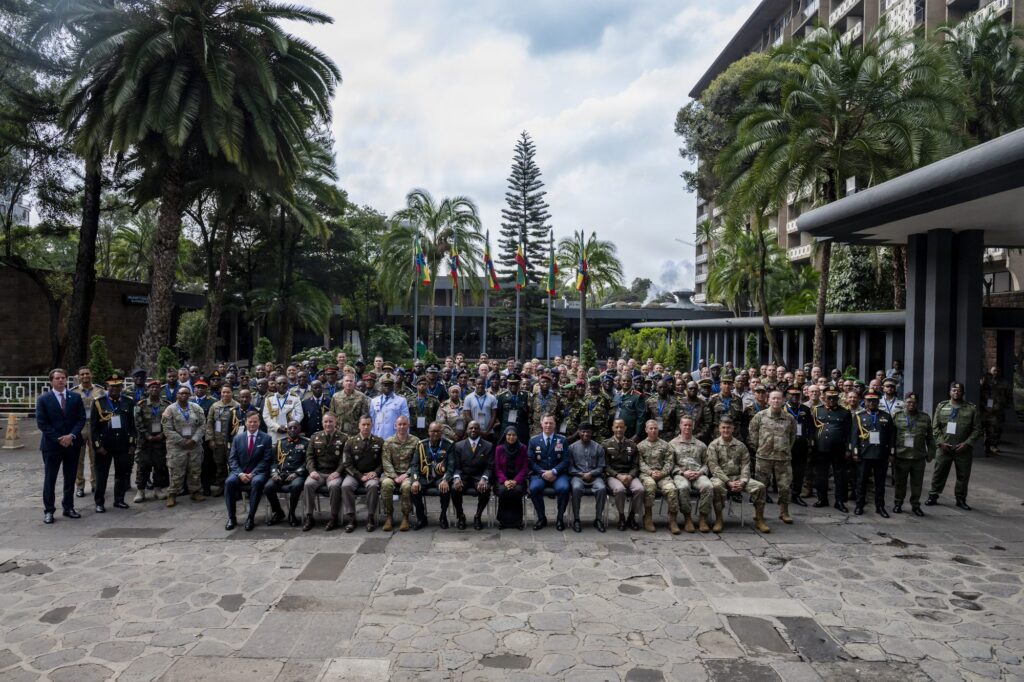
The United States is seeking to deepen its economic and security footprint across Africa through a blend of commercial investment, logistics cooperation and emerging technologies, senior U.S. officials said during a digital press briefing from the 2026 Africa Logistics and Communications Symposium (ALCS26) in Addis Ababa.
Speaking to journalists from across the continent, Deputy Assistant Secretary of Commerce Mark Mitchell and Brigadier General Paul G. Filcek, Director of Logistics at U.S. Africa Command (AFRICOM), presented a vision that ties Africa’s future prosperity to stronger logistics networks, secure communications systems and the adoption of artificial intelligence.
The symposium, hosted jointly by AFRICOM and Ethiopia’s Ministry of Defense, has brought together representatives from 40 African countries and 27 private-sector companies, making it the largest functional event of its kind organized by AFRICOM.
“We are at an inflection point,” Filcek said. “The digital age of expanding satellite constellations, networked drones, globally enabled communications, and accelerating artificial intelligence is rapidly changing not just warfare but the foundational structures of society.”
Security and economic growth increasingly intertwined
A recurring theme throughout the briefing was the argument that security and economic development are inseparable.
Mitchell described logistics and communications infrastructure as essential foundations for economic growth, arguing that stable and secure environments attract investment and create opportunities for long-term development.
“The United States uniquely integrates economic, security, and technological cooperation,” Mitchell said. “We don’t just build projects; we build the conditions for sustainable growth.”
The comments come as African governments increasingly balance relationships with multiple global powers, including China, the European Union, Türkiye and Gulf states, while seeking financing for major infrastructure and digital transformation projects.
Asked what distinguishes Washington’s approach, Mitchell emphasized long-term commercial partnerships, transparent governance and private-sector-led investment rather than dependency-driven financing models.
“Our private sector invests for the long term, helping to build durable commercial ecosystems,” he said.
Ethiopia emerges as a strategic partner
Mitchell highlighted Ethiopia as a growing destination for U.S. investment and technological cooperation.
During his visit, he held meetings with Ethiopian government officials, private-sector partners and executives from Ethiopian Airlines, Africa’s largest carrier.
Particular attention was given to the planned Bishoftu International Airport project, a multibillion-dollar initiative expected to significantly expand Ethiopia’s aviation capacity.
“Across agencies, the U.S. Government is committed to exploring ways to support the realization of this transformative project,” Mitchell said.
He also pointed to opportunities for collaboration between the United States and Ethiopia in artificial intelligence following discussions with the country’s Artificial Intelligence Institute.
The visit comes as Ethiopia continues economic reforms aimed at attracting foreign investment and strengthening its position as a regional economic hub.
AI becomes a new battleground for influence
Artificial intelligence emerged as one of the most significant topics during the briefing.
Mitchell argued that AI could revolutionize African supply chains by improving route planning, forecasting demand, reducing transport costs and streamlining customs operations across borders.
At the same time, he acknowledged growing concerns among African governments about technological dependence and data sovereignty.
“Real AI sovereignty means owning and using best-in-class technology for the benefit of your people and nation,” he said. “Strategic autonomy alongside rapid adoption—not isolation.”
The Commerce Department official promoted U.S. technology ecosystems as offering stronger security protections, transparency and intellectual property safeguards, while encouraging African governments to maintain control over their own data and digital infrastructure.
The remarks reflect increasing global competition over AI infrastructure, cloud services and digital governance frameworks as governments worldwide race to secure technological leadership.
AFRICOM focuses on self-reliance
For AFRICOM, the symposium was also an opportunity to showcase efforts aimed at helping African militaries become more self-sufficient.
Filcek highlighted the command’s A3I framework—Assess, Advise, Advocate and Integrate—which seeks to strengthen partner capabilities while gradually reducing dependence on U.S. logistical support.
The program, he said, is designed to improve interoperability among African forces and support regional security cooperation.
The initiative is particularly relevant as African nations confront rising transnational threats, including human trafficking, organized crime and drug trafficking.
Filcek warned that narcotics trafficking across the continent has increased dramatically in recent years, creating new security challenges that require stronger coordination and logistics capabilities.
“Meeting and defeating these grave threats requires cooperation, coordination, effective and reliable communications, and the ability to rapidly move people, equipment, and supplies,” he said.
A new model for defense cooperation
One of the most notable changes unveiled at ALCS26 is the decision to merge logistics and communications into a single continental forum.
Previous conferences had treated the two areas separately, but AFRICOM officials now argue that modern military operations require an integrated approach.
“Logistics and communications can no longer be considered separately,” Filcek said. “You cannot have one without the other.”
He described logistics as the “spine” of military operations and communications as the “nervous system,” arguing that success increasingly depends on the ability to combine both capabilities effectively.
The symposium’s broader focus also reflects growing recognition that military readiness is shaped not only by weapons and personnel but by supply chains, transportation networks, communications infrastructure and private-sector innovation.
As global powers compete for influence in Africa, the messages delivered in Addis Ababa underscored Washington’s effort to position itself as a long-term partner in both security and economic development.
The symposium highlighted sectors likely to define future cooperation: aviation, digital infrastructure, logistics corridors, artificial intelligence and regional supply chains.
For African governments, the challenge will be balancing opportunities offered by competing global partners while maintaining sovereignty over critical infrastructure, data and development priorities.
For the United States, the goal is clear: strengthen partnerships that link security, investment and technology at a time when Africa’s strategic importance is rising on the global stage.
The Africa Logistics and Communications Symposium (ALCS26) runs from July 27–31 in Addis Ababa, Ethiopia, bringing together military leaders, government officials and private-sector representatives from across Africa and the United States.