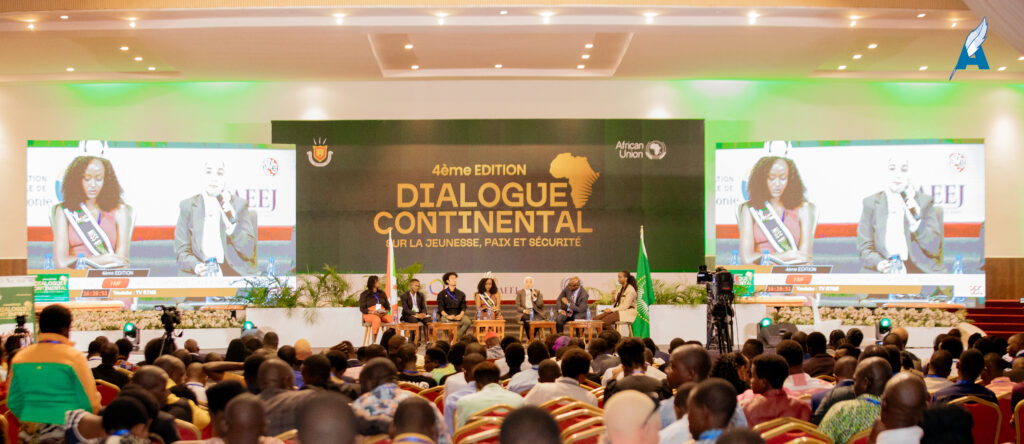
Burundi hosted, from December 11 to 12, 2025, the 4th edition of the Continental Dialogue on Youth, Peace and Security, a major African Union gathering that brought together thousands of young people from all regions of the continent. Organized by the African Union Commission under the high patronage of Évariste Ndayishimiye, President of the Republic of Burundi and African Union Champion for the Youth, Peace and Security Agenda, the event took place at the Presidential Palace of Kiriri, a strong symbol of high-level political commitment.
Held under the theme “Beyond speeches: empowering and engaging youth in the sustainable development of agri-food systems and mineral value chains as a key driver of the continental youth, peace and security agenda,” this edition marked a turning point, moving from intentions to concrete action, at a time when the continent continues to face persistent security, economic, and social challenges.
From the opening ceremony, the strong institutional mobilization set the tone. Alongside the Burundian Head of State were the Presidents of the Supreme Court and the Constitutional Court, the Ombudsman, members of the Government, the African Union High Representative to Burundi and the Great Lakes Region, the President of the Pan-African Youth Union, the President of the Commission of the Economic Community of Central African States (ECCAS), accredited diplomats, representatives of international organizations and United Nations agencies, including UNDP, as well as the Governor of Bujumbura Province.
At the heart of the dialogue was the voice of young people. Presented by the African Youth Peace Ambassadors representing the continent’s regions, the objectives of the dialogue were clearly outlined: to synthesize and elevate African youth perspectives in regional, continental, and global peace and security debates, particularly within the framework of the New Agenda for Peace (NA4P); to strengthen young people’s capacities and understanding of the YPS framework; to provide networking and exchange platforms, especially for adolescent girls and young women; and to reinforce youth contributions to peace-building policies and actions in Africa and beyond.
In this context, the President of the National Youth Council of Burundi Dr. Thierry Ingabire highlighted the country’s experience as an example of meaningful youth participation. He recalled the active involvement of young people in drafting the National Youth, Peace and Security Strategy, in collaboration with UNDP and UNFPA. With support from the Peace-building Fund, Burundian youth are now engaged in community mediation, conflict prevention, and the strengthening of social cohesion. Rejecting a passive vision of youth, he called for their recognition as strategic partners and proposed the creation of a continental youth innovation and investment fund, the strengthening of exchange, mentorship, and leadership programs, as well as the establishment of regional incubators in agro-industry, digital innovation, mining, and social innovation.
This message was echoed by Mahmoud Dialla, President of the Pan-African Youth Union, who spoke on behalf of African youth. Expressing deep appreciation for President Ndayishimiye’s commitment, he emphasized that peace must go beyond rhetoric and be reflected in daily behavior and concrete public policies. According to him, making youth a priority is a strategic choice for building a modern, harmonious, and sustainable Africa.
The African Union High Representative to Burundi and the Great Lakes Region Sghair Said stressed the crucial role of youth in building lasting peace and socio-economic development, particularly in a region historically affected by recurrent crises. He underscored that effective implementation of the Youth, Peace and Security agenda—supported by stronger collaboration among institutions, governments, and youth themselves—is essential to transforming long-standing challenges into opportunities for stability and prosperity.
In his opening address, President Évariste Ndayishimiye delivered a powerful call to action. Recalling that nearly 70 percent of Africa’s population is young, he urged stakeholders never to underestimate this potential. Emphasizing the fight against poverty as a root cause of many social problems, he stated that dialogue must always come before war. He encouraged young people to embrace leadership, value work—particularly agriculture—and strive for financial independence, stressing that patience, collective effort, and determination can make transformation possible.
The second day of the dialogue, December 12, was devoted to in-depth thematic panels. The first panel examined youth empowerment and engagement in sustainable agri-food systems, mineral value chains, trade, entrepreneurship, and innovation, in line with the Kampala Declaration and the African Union’s raw materials strategy. The second focused on youth leadership in governance and the role of Generation Z in promoting sustainable development and peace across Africa.
The discussions were dynamic and forward-looking. Participants emphasized that Africa’s development begins with love for the continent, regretting that some young people, once financially able, choose to travel to Europe rather than explore African countries. On mineral resources, youth called on governments to invest in local processing instead of exporting raw materials, to create jobs and enhance economic self-reliance. A bold proposal also emerged: replacing ethnic-based political quotas with intergenerational representation, ensuring a balance between youthful innovation and the experience of elders.
Gender equality featured prominently in the exchanges. Responding to concerns about the low participation of young women in development initiatives, Désiré Manirakiza, National Coordinator of PAEEJ, highlighted persistent socio-cultural barriers. He called for a deep shift in mindset, stressing that women’s economic empowerment is a key driver of social transformation and influence.
Social media was also identified as a powerful tool for development, provided it is used responsibly. Influencers were encouraged to mobilize their audiences around positive, transformative content rather than focusing solely on entertainment.
As the 4th edition of the Continental Dialogue on Youth, Peace and Security draws to a close on December 13 with the celebration of Inkerebutsi Day, dedicated to African youth, one clear message emerges from Bujumbura: Africa’s young people no longer wish to be mere spectators. They are determined to be central actors in peacebuilding, governance, and the sustainable development of the continent.