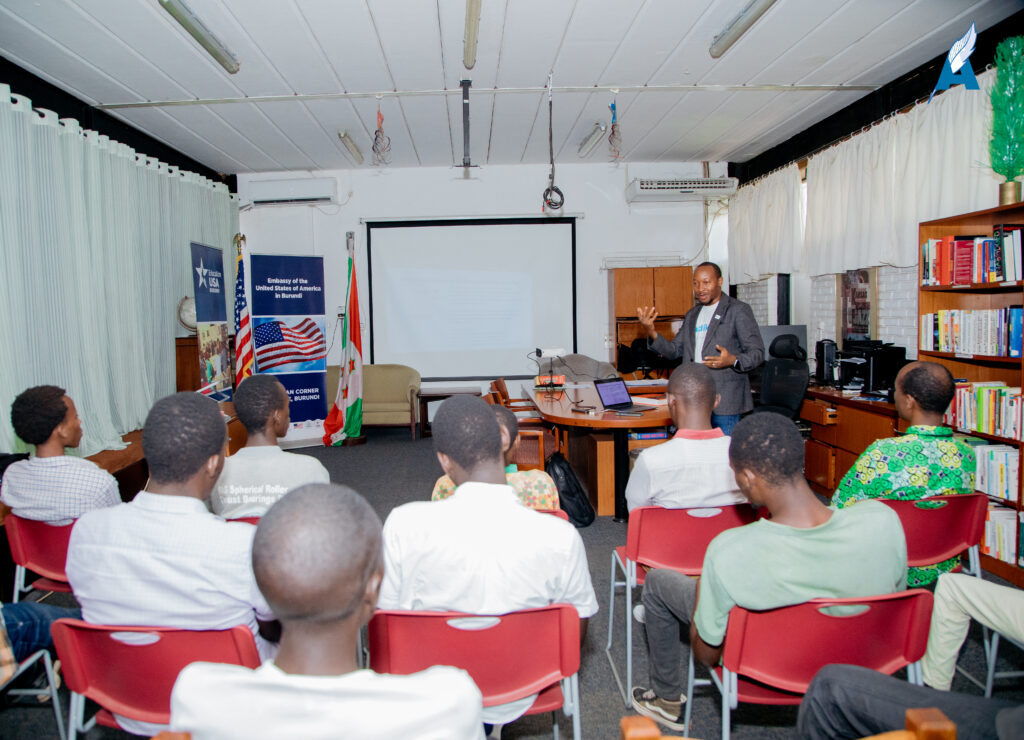
At a time when global press freedom is at its lowest point in decades, journalists, students, and media professionals gathered at the American Corner, Kamenge Campus to confront a pressing question: can journalism still shape a peaceful future? On May 5, 2026, in recognition of World Press Freedom Day—observed annually on May 3 since 1993, Andika Magazine convened a public discussion under the 2026 World Press Freedom Day theme: “A Future at Peace: Promoting Human Rights, Development, and Security,” led by journalist and Executive Director Melchisedeck Boshirwa.
The discussion opened with a stark global reality. According to recent findings by Reporters Without Borders, more than half of the world’s countries now fall under “difficult” or “very serious” press freedom conditions—the worst level recorded in 25 years. The information space is shrinking, and journalism is increasingly under pressure from political, economic, and technological forces.
Yet, within this global decline, Burundi presents a more nuanced picture.
A country in cautious transition
Participants were reminded that Burundi has made measurable, though fragile, progress. The country climbed from 125th to 119th position in the global press freedom ranking in 2026—a modest but significant shift. More notably, as of May 3, 2026, no journalists were reported to be detained in the country, marking a break from previous years.
“This is a step forward,” Boshirwa noted during his presentation, “but progress without safeguards can quickly reverse.”
The evolution of Burundi’s media landscape reflects a broader trend of cautious reopening since 2023, supported by legal reforms and reduced direct repression. However, underlying challenges persist. Self-censorship, limited access to public information, and economic vulnerability continue to shape newsroom realities.
Why press freedom still matters
At the heart of the discussion was a central argument: press freedom is not an abstract ideal—it is a functional pillar of peace.
Drawing from principles rooted in the Windhoek Declaration and reinforced by UNESCO, the session emphasized that a free press enables informed citizens, accountable leadership, and protected human rights.
Without it, the consequences are immediate and tangible. “When information is controlled,” Boshirwa explained, “citizens hear only one side of the story. Corruption thrives in silence, and trust in institutions erodes.”
Participants explored real-life implications—from local governance to everyday community issues—highlighting how journalism influences decisions about education, safety, and public policy. In this sense, press freedom becomes not just a professional concern, but a societal one.
Between rights and responsibilities
The conversation also turned inward, examining the role of journalists themselves. Freedom of the press, guest speaker stressed, is inseparable from responsibility.
Journalists are entitled to publish without censorship, access information, and protect sources. In return, they are expected to uphold accuracy, fairness, and objectivity—principles that remain essential in an era increasingly defined by misinformation and digital noise.
The rise of artificial intelligence and the spread of unverified content on platforms like WhatsApp and Facebook were identified as emerging threats in Burundi. For young journalists in attendance, the message was clear: credibility is the currency of modern journalism.
A shared future at stake
As the session concluded, the focus shifted from diagnosis to responsibility. What role can youth play? How can communities support independent media? And crucially, how can fragile gains be protected ahead of future political milestones?
The answers were not definitive—but the urgency was unmistakable.
Press freedom, participants agreed, is both a right and a continuous struggle. Its defense requires not only legal frameworks but also ethical journalism, engaged citizens, and sustained vigilance.
In a world where peace is increasingly tied to the integrity of information, the message from American Corner, Kamenge Campus discussion about press freedom in Burundi was simple but profound: journalism still matters—and its future depends on those willing to protect it.