Four Burundian civil society organizations have appealed to President Évariste Ndayishimiye, in his capacity as chairperson of the African Union, to intervene over what they describe as growing xenophobia and discrimination against Africans in other African countries.
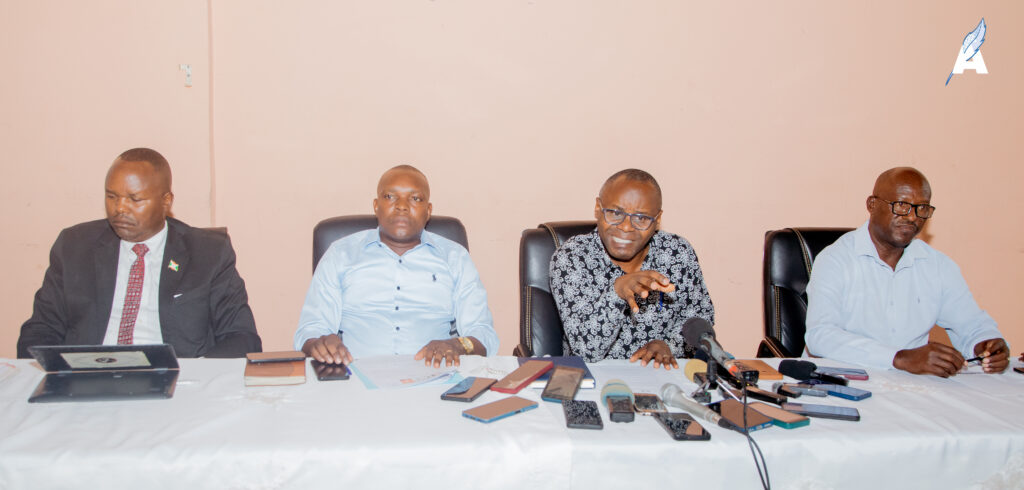
The Observatory for the Fight Against Corruption and Economic Malpractices (OLUCOME), the Burundian Association of Consumers (ABUCO), the National Observatory for the Fight Against Transnational Crime (ONLCT) and the Burundian Association for the Fight Against Unemployment and Torture (ALUCHOTO) made the appeal Wednesday in Bujumbura while publicly presenting an open letter addressed to Ndayishimiye.
The organizations said the issue had become particularly urgent amid concerns over the treatment of Burundians in Kenya following the Kenyan government’s recent crackdown on foreigners operating small-scale businesses.
The Kenyan government has said foreign nationals operating businesses without the required permits must regularize their status. It subsequently announced a 90-day period for foreigners to regularize immigration documents, work permits, business registrations and licenses. The government has also warned against harassment and discrimination.
Conflicting figures over Burundian deaths
During the press conference, Vianney Ndayisaba, who heads ALUCHOTO, said figures compiled by the organizations indicated that 37 Africans had been killed in Kenya, Zambia, Tanzania and Oman, while 484 had allegedly been detained unlawfully and 192 physically assaulted.
Prime Mbarubukeye, president of ONLCT, gave a separate figure concerning Burundians in Kenya.
“73 have already been killed there in Kenya, while 234 have been imprisoned,” he said.
The figure of 73 alleged deaths has also been reported by Burundian media as a claim made by ONLCT. However, it has not been independently established by the available reporting. A BBC report on the situation cited a Burundian representative in Kenya as saying that the number known to him was seven Burundians who had died, with those cases involving separate allegations and circumstances.
The discrepancy underscores the need for further independent verification of the figures.
OLUCOME President Gabriel Rufyiri said the situation was particularly concerning because, in his view, Burundians affected by the crisis lacked sufficient representation.
“It is sad to see what is happening to Burundians while they have no one to speak for them, even though there are institutions responsible for doing so,” Rufyiri said.
He also questioned the response of East African institutions, arguing that the East African Legislative Assembly, which is currently led by a Burundian, had not done enough to address the concerns.
Pierre Nduwayo of ABUCO attributed the broader phenomenon to several factors, including poverty, population growth, conflicts and poor governance.
Ndayisaba argued that violations of human rights should not be used as a means of dealing with migration or foreign nationals.
“Harassing people’s human rights is not the solution to expelling foreigners,” he said, calling instead for countries to engage in dialogue and agree on peaceful ways of resolving disputes.
Organizations call for stronger African integration
In their open letter, the organizations argued that xenophobia threatens the principles of African solidarity and Pan-Africanism. They said violence, discrimination and exclusion based on nationality contradict the continent’s stated commitments to regional integration and the free movement of people.
They called on the African Union to take action against member states where xenophobic practices occur and to encourage governments to uphold international agreements protecting civil, political, economic and social rights.
The organizations also called for faster implementation of free-movement agreements, the removal of unnecessary administrative and customs barriers, and simplified procedures for visas, residence and work permits.
Among their recommendations is the creation within the East African Community of a more integrated mobility system, including consideration of a common biometric visa, while making it easier for citizens to obtain residence and work documentation.
They also urged governments to harmonize the recognition of academic and professional qualifications, strengthen social-security cooperation, develop regional transport corridors and expand economic and commercial integration.
Other proposals include greater use of digital systems to manage cross-border movements, stronger cooperation against transnational crime and increased investment in Africa’s young population.
The organizations said African countries should educate their populations about the benefits of free movement and ensure that migration within the continent is viewed as an economic and social opportunity rather than a threat.
They warned that if their concerns are not adequately addressed, they would seek to work with other international organizations to advocate for the protection of Burundians and other Africans affected by discrimination.
The appeal comes as hundreds of Burundians have sought travel documents at their embassy in Nairobi amid uncertainty surrounding Kenya’s restrictions on foreign small-scale traders.
The four organizations said their broader objective was to encourage African governments to resolve migration and economic disputes through dialogue while protecting the rights and dignity of citizens across the continent.