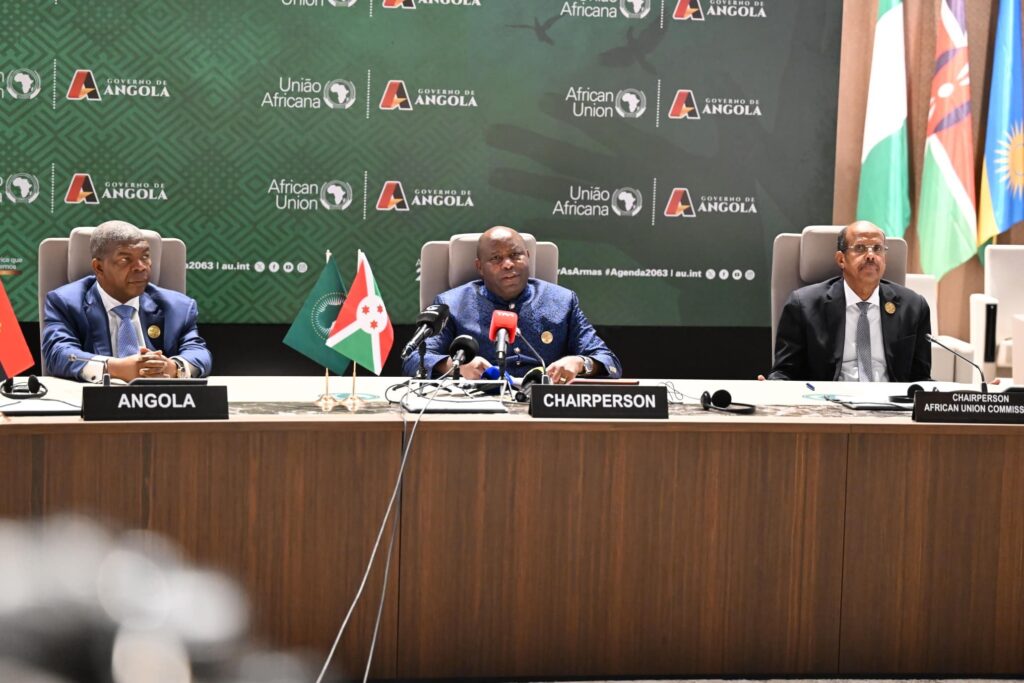
Burundi’s President and current African Union chairperson, Evariste Ndayishimiye, has called on African leaders to accelerate efforts to prevent and resolve conflicts across the continent, warning that poor governance, exclusion and poverty continue to fuel instability.
Ndayishimiye made the remarks Sunday, August 30, 2026, in Luanda, Angola, where he chaired the 21st Extraordinary Session of the African Union Assembly of Heads of State and Government. The meeting focused on strengthening Africa’s mechanisms for conflict prevention and resolution.
Speaking at the opening of the summit, Ndayishimiye said Africa faces multiple and interconnected security threats, including terrorism, transnational crime and tensions between neighboring states.
He argued that the continent already has the institutions and mechanisms needed to address such crises, but often lacks the speed required to respond effectively.
“Africa does not need new tools. It already has its Peace and Security Council, its early warning system and its standby force. The problem is the reaction time,” Ndayishimiye said.
Tackling the roots of conflict
The Burundian president pointed to conflicts in Sudan, the Sahel and eastern Democratic Republic of Congo as examples of crises requiring long-term solutions.
He said efforts to end wars must go beyond addressing their immediate causes and tackle deeper structural problems, including poor governance, exclusion, inequality and poverty.
“An empty stomach has no ears,” Ndayishimiye said, stressing the vulnerability of young people facing poverty and a lack of opportunities.
He warned that young people without economic or social prospects can become easy recruits for armed groups, making investment in Africa’s youth a key component of long-term peace and security.
Burundi offers reconciliation experience
Ndayishimiye also highlighted Burundi’s experience with reconciliation, pointing to the 2000 Arusha Agreement as an important milestone in the country’s efforts to overcome years of ethnic divisions.
He urged other African countries facing conflict to consider lessons from Burundi’s reconciliation process.
The president also noted Burundi’s involvement in peacekeeping operations in Somalia, the Democratic Republic of Congo and the Central African Republic.
Ndayishimiye called on African leaders to build a continent that anticipates crises instead of merely responding to them after violence has erupted.
He advocated greater emphasis on mediation, reconciliation and dialogue as tools for preventing conflicts and strengthening lasting peace and stability.
Angola pledges cooperation
Angolan President João Manuel Lourenço, who also addressed the summit, thanked Ndayishimiye in his capacity as chairperson of the African Union.
Lourenço said Angola and other AU member states would work together to strengthen the implementation of continental mechanisms designed to prevent and resolve conflicts.
“We will do everything to avoid conflicts on the continent so that Africa can be free and prosperous,” Lourenço said.
Turning decisions into action
Following the opening ceremony, African heads of state and government continued discussions behind closed doors.
According to Ndayishimiye, the summit’s conclusions emphasized the need to ensure that decisions taken by the African Union are effectively implemented and translate into tangible results on the ground.
The extraordinary session brought together African heads of state and government, the chairperson of the African Union Commission, leaders of AU institutions and organs, representatives of international and regional organizations, and development partners.
The summit comes as several parts of Africa continue to face armed conflicts and political instability, underscoring the AU’s push for stronger preventive diplomacy and faster responses to emerging crises.